Open any live flight tracker online today and you’ll see thousands of aircraft moving across a world map in real time — climbing, cruising, banking into approach paths, landing at airports thousands of miles apart. It feels almost magical, but behind that smooth, glowing map is a genuinely fascinating web of satellites, ground receivers, radar networks, and data pipelines working together to update your screen every few seconds.
In 2026, real-time flight tracking has become more accurate, more accessible, and more widely used than ever — not just by aviation professionals, but by everyday travelers, families waiting at the gate, cargo logistics teams, and aviation enthusiasts who simply enjoy watching planes cross the globe. This guide breaks down exactly how a real time airplane tracking system works, what technology powers it, and how to actually use these tools to track flights live with confidence.
Why Live Flight Tracking Has Become So Popular
A decade ago, checking on a flight meant calling an airline or refreshing a departures board at the airport. Today, anyone can open an app and track flight live, down to the exact altitude, speed, and estimated arrival time of a specific aircraft, often from anywhere in the world.
A few factors have driven this shift:
1. Increased flight volume. With global air travel continuing to grow, more people have a personal reason to check on a flight — picking someone up, coordinating a connection, or simply managing travel anxiety.
2. Better data accessibility. Aviation data that used to be restricted to air traffic controllers and airlines is now available through open ADS-B networks, making live tracking far more transparent.
3. Smartphone-first travel habits. Nearly everyone now expects the same real-time visibility from a flight tracking app that they get from a rideshare app or delivery tracker.
4. Logistics and cargo demand. Businesses tracking freight, charter flights, or corporate travel rely on real time flight tracking apps to manage schedules and respond quickly to delays.
How a Real-Time Airplane Tracking System Actually Works
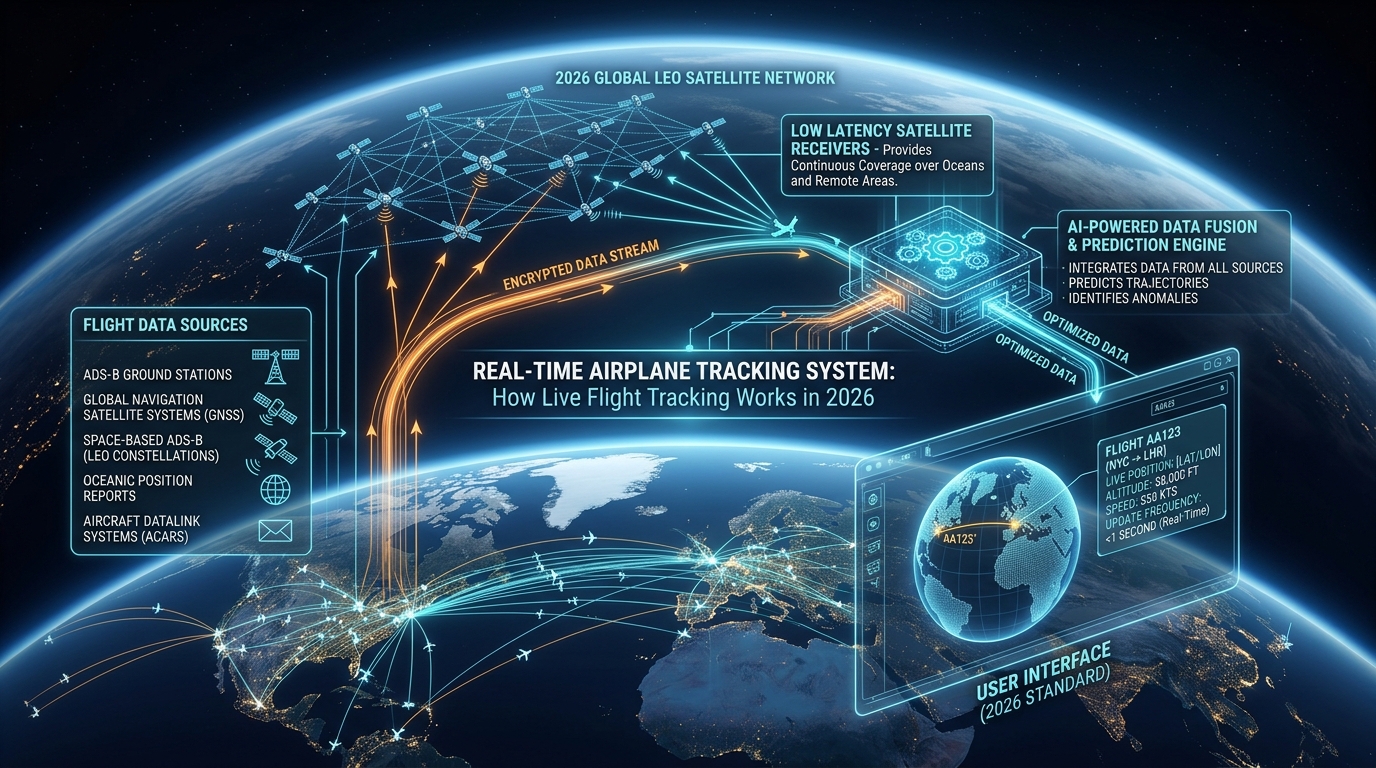
At its core, a real time airplane tracking system pulls together several independent data sources and merges them into a single, continuously updating live map. Here’s how the process breaks down.
1. ADS-B: The Backbone of Modern Flight Tracking
Automatic Dependent Surveillance-Broadcast, or ADS-B, is the technology responsible for most of what you see on a live flight tracker with map today. Aircraft equipped with ADS-B transponders continuously broadcast their GPS-derived position, altitude, speed, and heading roughly once per second.
Ground-based receivers — often operated by aviation enthusiasts, tracking companies, and official aviation authorities — pick up these signals and relay them to central servers. That data is then processed and displayed on the live maps used by flight tracking platforms.
2. Satellite-Based Tracking for Oceanic and Remote Routes
Ground receivers work well over populated land areas, but they can’t cover the middle of an ocean or remote airspace. This is where satellite-based ADS-B comes in. Networks of low-earth-orbit satellites now pick up ADS-B signals from aircraft flying over oceans, polar routes, and other remote regions, closing the coverage gaps that used to leave transoceanic flights essentially invisible on tracking maps for hours at a time.
This satellite layer is one of the biggest upgrades to real-time airplane tracking systems in recent years, and it’s a major reason why users can now track international flights live across an entire journey — not just the portions near major airports.
3. Radar Data From Air Traffic Control Networks
In regions where ADS-B coverage is still limited, or for aircraft not broadcasting ADS-B data, tracking platforms often supplement with secondary surveillance radar data sourced from air traffic control systems. This adds another layer of accuracy, particularly for older aircraft or specific airspace regions with less ADS-B ground infrastructure.
4. Flight Plan and Schedule Data
Beyond live position data, a flight tracking arrivals and departures system also pulls in scheduled flight data directly from airlines and airports — flight numbers, scheduled departure and arrival times, gate assignments, and aircraft type. This is what allows a flight tracker to show not just where a plane is right now, but whether it’s on time, delayed, or diverted, and to let users track flight by number live rather than needing to know exact coordinates.
5. Data Aggregation and the Live Map Display
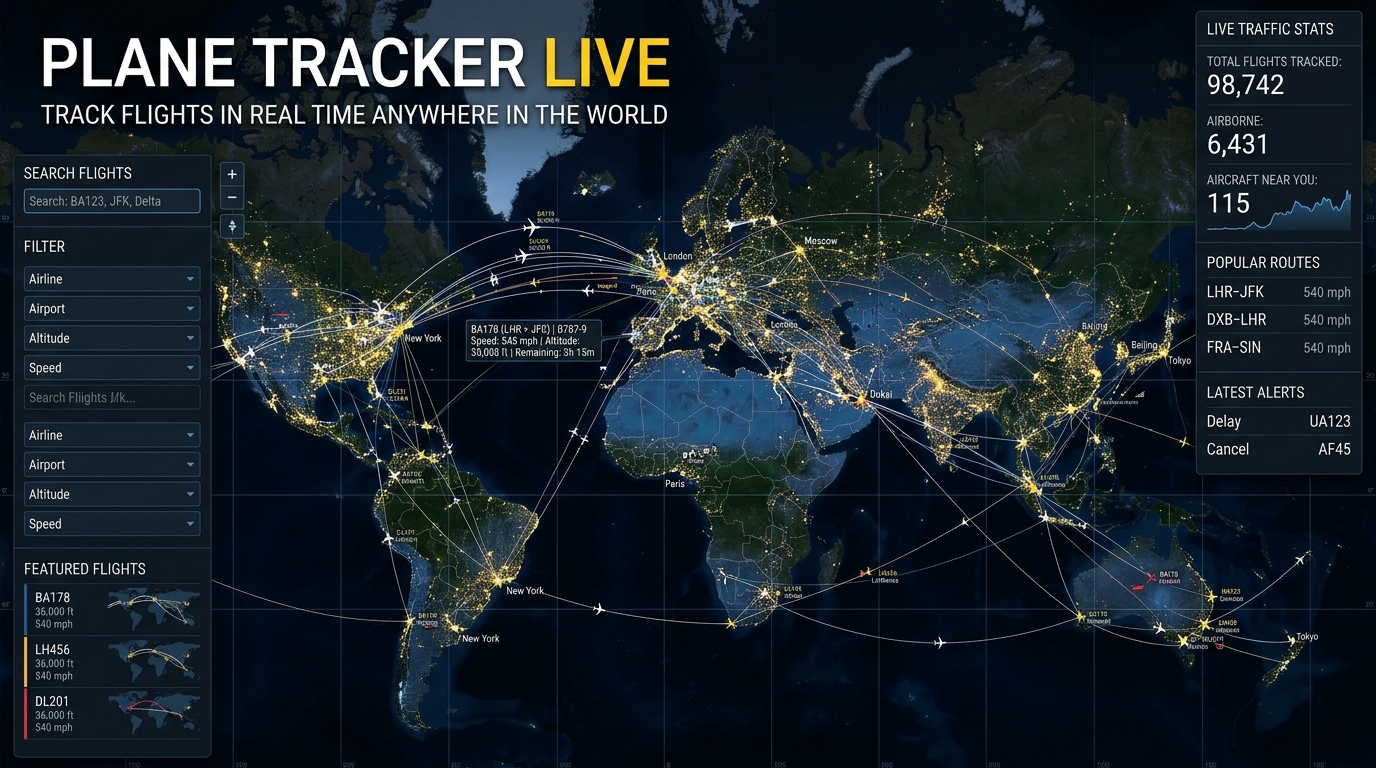
All of these sources — ADS-B ground stations, satellite feeds, radar data, and airline schedule data — get merged by the tracking platform’s backend systems. The result is what users see: a live airplane tracker map showing aircraft icons moving smoothly across the globe, each one clickable for details like altitude, ground speed, origin, destination, and flight status.
What You Can See on a Modern Flight Tracker
A quality real time flight tracking app in 2026 typically shows far more than just a moving dot on a map. Standard details usually include:
- Current altitude and ground speed
- Heading and flight path (past and projected)
- Origin and destination airports
- Scheduled vs. estimated arrival time
- Aircraft type and, on many platforms, tail number
- Departure and arrival gate information
- Delay status and reason (when available)
- Historical flight path playback
Some more advanced platforms also layer in live weather overlays, turbulence forecasts, and airspace congestion data — giving users a much fuller picture of what’s actually happening around a specific flight, not just its dot on the map.
Best Flight Tracker Apps in 2026: What to Look For
With dozens of options available, choosing the best flight tracker app comes down to a few practical factors:
Accuracy and Update Frequency
The best real time flight tracker apps refresh aircraft positions every few seconds rather than every minute or longer. Faster refresh rates matter most for people actively watching a flight during takeoff, landing, or turbulence-heavy conditions.
Global Coverage
Since ADS-B ground coverage varies by region, apps that combine satellite tracking with terrestrial data tend to offer far more consistent global coverage — especially important for anyone trying to track international flights live over oceans or remote airspace.
Free vs. Premium Features
Most flight tracking app free tiers cover the basics — live position, scheduled times, and basic flight status. Premium tiers usually unlock features like ad-free tracking, more detailed weather overlays, historical flight data, and multi-flight watchlists, which are especially useful for frequent travelers or logistics professionals.
Interface and Map Usability
A cluttered map with too much overlapping data can actually make it harder to track flight live. The strongest apps balance detail with clarity — clean map design, intuitive search, and quick access to arrivals and departures boards without requiring multiple taps to find basic information.
Notification and Alert Systems
A strong live flight status tracker should proactively notify users of gate changes, delays, and cancellations rather than requiring users to manually refresh. This is one of the most valued features among frequent flyers and anyone coordinating airport pickups.
How to Track a Flight in Real Time: Step-by-Step
For anyone new to flight tracking, the process is simpler than it might seem:
- Choose a live flight tracker online or download a flight tracker app. Most major platforms offer both a website version and a mobile app.
- Search by flight number or route. Entering the airline code and flight number is usually the fastest way to track flight by number live, though you can also search by departure and arrival airport.
- View the live map. Once located, the aircraft will appear as an icon on a live airplane tracker map, updating in near real-time as it moves along its route.
- Check flight details. Tap or click the aircraft icon to view altitude, speed, estimated arrival time, and current status.
- Set alerts if needed. Many apps allow you to follow a specific flight and receive push notifications for delays, gate changes, or landing confirmation.
This process works whether you’re tracking a short domestic hop or trying to track international flights live across multiple time zones.
Live Air Traffic Tracker: Watching More Than One Flight at a Time
Beyond tracking a single flight, many enthusiasts and professionals use a live air traffic tracker to view broader air traffic patterns — entire regions of airspace filled with dozens or hundreds of aircraft simultaneously. This view is particularly popular among:
- Aviation enthusiasts (often called “planespotters”) who enjoy watching air traffic patterns, identifying aircraft types, or tracking specific historic or notable aircraft
- Logistics and cargo teams monitoring multiple shipments across different flights at once
- Airport operations staff cross-referencing live traffic with ground operations
- Journalists and researchers tracking flight patterns during major news events, natural disasters, or geopolitical developments
A full live air traffic tracker view essentially turns the entire sky into a real-time dashboard, and it’s one of the more visually striking uses of modern flight tracking data.
Flight Radar Live: Understanding the Terminology
You’ll often see terms like “flight radar,” “live flight tracker,” and “real-time airplane tracking system” used somewhat interchangeably, but there are subtle differences worth understanding:
- Flight radar live generally refers to platforms that visualize ADS-B and radar data on a live map, similar to how weather radar visualizes storm systems.
- Live flight tracker usually refers to the broader category of apps and websites offering real-time flight position and status data.
- Real-time airplane tracking system describes the underlying infrastructure — the combination of ADS-B receivers, satellites, radar feeds, and data processing — that powers the tracker itself.
Understanding this distinction helps when comparing platforms, since some prioritize a radar-style visual experience while others focus more on flight status, scheduling, and arrivals and departures data.
Common Use Cases for Real-Time Flight Tracking in 2026
Airport Pickups and Personal Travel
One of the most common everyday uses of a live flight status tracker is simply knowing when to leave for the airport to pick someone up. Instead of guessing based on a scheduled time, users can track flight live and adjust their timing based on actual arrival estimates.
Business Travel Coordination
Companies managing employee travel increasingly rely on real time flight tracking apps to monitor delays and rebook connections proactively, reducing downtime and missed meetings.
Cargo and Logistics Management
Freight companies and supply chain teams use flight tracking arrivals and departures data to coordinate ground transportation, warehouse staffing, and delivery timelines around actual aircraft arrival times rather than fixed schedules.
Aviation Enthusiasts and Planespotting
A large and passionate community uses live airplane trackers purely out of interest — following specific aircraft, spotting rare plane types, or tracking historic flights and special routes.
Safety Monitoring and Family Reassurance
During weather events or when following a loved one’s journey, being able to track a flight in real time offers peace of mind that a scheduled arrival board simply can’t provide.
The Future of Real-Time Airplane Tracking Systems
Flight tracking technology continues to evolve, and a few trends are shaping where it’s headed:
Improved satellite coverage is closing the remaining tracking gaps over oceans and remote regions, meaning full end-to-end tracking of international flights is becoming the standard rather than the exception.
AI-powered delay prediction is increasingly being layered into tracking platforms, using historical data and current conditions to forecast delays before they’re officially announced.
Integration with airport and airline systems is making live tracking data more consistent, pulling gate changes and status updates directly from operational systems rather than relying solely on public broadcast data.
More detailed weather and turbulence overlays are giving travelers a fuller understanding of what’s happening around their flight, not just where it currently is.
Final Thoughts
What used to require specialized aviation equipment or insider access is now available to anyone with a smartphone. A real-time airplane tracking system in 2026 combines ADS-B ground networks, satellite coverage, radar data, and airline scheduling information into a single, easy-to-read live map — letting anyone track flight live, monitor arrivals and departures, or simply watch global air traffic unfold in real time.
Whether you’re coordinating an airport pickup, managing business travel, tracking cargo shipments, or just enjoy watching planes move across a live map for fun, today’s best flight tracker apps make real-time flight tracking more accurate, more accessible, and more useful than it’s ever been.