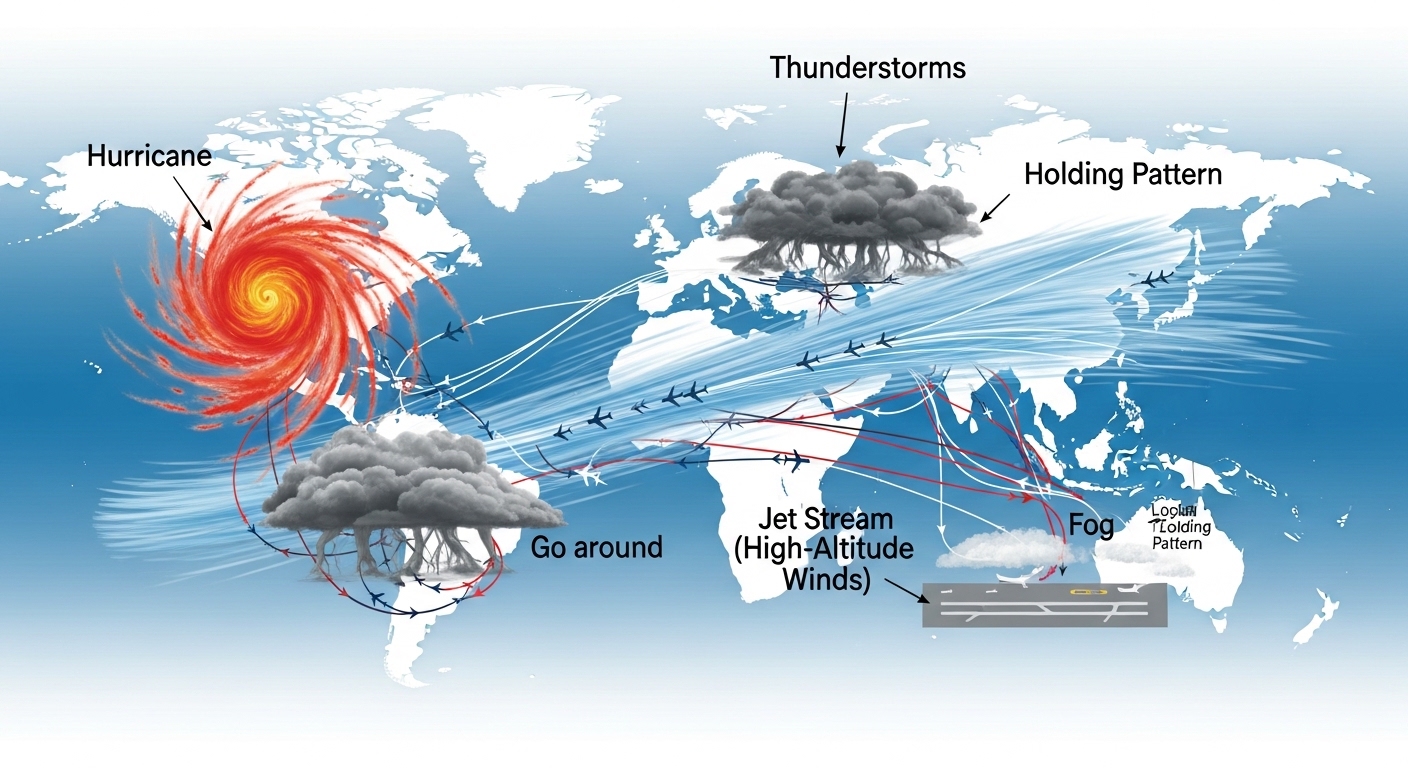
Weather is one of the most important factors in aviation, shaping how, where, and when airplanes can safely fly. Whether you’re a passenger wondering why your flight takes a longer route—or an aviation enthusiast trying to understand real-time flight tracking—weather plays a huge role in the skies above us.
This guide explains how weather affects flight paths, why airlines adjust routes, and how modern technology predicts and avoids dangerous conditions.
1. Why Weather Matters in Aviation
Airplanes are built to handle challenging environments, but pilots and air traffic controllers always avoid unnecessary risk. Certain weather conditions can:
- Slow the aircraft
- Increase fuel burn
- Create turbulence
- Reduce visibility
- Increase icing risk
- Trigger delays or rerouting
Modern aviation focuses on safety first, efficiency second—and weather directly impacts both.
2. The Main Weather Factors That Change Flight Paths
A. Jet Streams
Jet streams are powerful winds, often reaching 150–250 mph.
They can push flights faster or slow them dramatically.
- Eastbound flights (US → Europe, Asia → US West Coast) often ride tailwinds.
- Westbound flights often avoid strong headwinds, adding miles or altitude changes.
Jet stream routing saves airlines millions in fuel yearly.
B. Thunderstorms
Pilots never fly through thunderstorms. They contain:
- Severe turbulence
- Lightning
- Hail
- Updrafts and downdrafts
- Microbursts
Thunderstorm avoidance sometimes adds tens or hundreds of miles to a route, especially in tropical regions like Southeast Asia.
C. Turbulence
Modern airlines receive live turbulence forecasts.
To avoid rough air, flight paths may include:
- Altitude changes
- Slight lateral deviations
- New routing given by ATC
Many turbulence events come from clear-air turbulence (CAT), which is invisible on radar and often forms near jet streams.
D. Icing Conditions
Live Flight Tracker Icing occurs in clouds containing supercooled water. If an aircraft flies through these pockets, ice can accumulate on:
- Wings
- Sensors
- Engines
To avoid hazardous icing levels, pilots may:
- Climb or descend
- Reroute horizontally
- Adjust speed or configuration
E. Volcanic Ash
Volcanic ash is incredibly dangerous—it can damage engines and sensors.
ATC and global volcanic monitoring systems create no-fly zones, forcing long detours over areas like:
- Alaska
- Indonesia
- Iceland
- The Philippines
In 2010, the Icelandic ash cloud grounded thousands of flights globally.
F. Strong Winds During Arrival or Departure
Crosswinds and low visibility at airports often require:
- Changing runway direction
- Holding patterns
- Reroutes to alternate airports
- Delay until conditions improve
Runways have wind limits—exceeding them makes landing unsafe.
3. How Pilots and Air Traffic Control Manage Weather
Modern fleets use advanced systems:
⚙ Weather Radar
Shows storms, rain, and cloud density ahead.
⚙ ACARS Weather Updates
Text-based weather reports directly from operations centers.
⚙ Satellite and ADS-B Weather Data
Provides live global weather patterns and wind speeds.
⚙ ATC Instructions
Controllers reroute traffic to maintain spacing around dangerous weather.
All these combine to create dynamic flight paths that adjust minute-by-minute.
4. Why Your Flight Takes a “Weird” Route
Sometimes your plane seems to make a strange turn or long loop. Common reasons include:
- Avoiding storm cells
- Staying clear of turbulence
- Bypassing volcanic ash
- Navigating jet stream boundaries
- Working around restricted military airspace
- Landing on a different runway based on wind conditions
It’s almost always due to weather or safety—not a mistake.
5. How Weather Affects Flight Tracking
On apps like FlightRadar24 or FlightAware, weather impacts:
- Sharp turns around storms
- Holding patterns
- High-altitude detours
- Slower ground speeds
- Extended arrival paths
Tracking apps often overlay weather radar so you can see exactly why a flight changed direction.
6. The Future: AI Weather Prediction in Aviation
By 2030, airlines will depend heavily on:
- AI-assisted turbulence prediction
- Machine learning wind models
- Satellite-based global weather forecasting
- Predictive analytics for route optimization
This will mean fewer delays, less fuel burn, and safer skies.
Conclusion
Weather is one of the most powerful forces shaping aviation. From jet streams to thunderstorms, turbulence to volcanic ash, every flight path is a careful balance between safety, efficiency, and real-time atmospheric conditions. Thanks to advanced radar, AI weather models, satellites, and ATC coordination, pilots can navigate complex skies safely and intelligently.
The next time your flight takes a longer route or arrives late, remember—the weather above us is constantly changing, and pilots are always working to keep flights safe, smooth, and efficient.