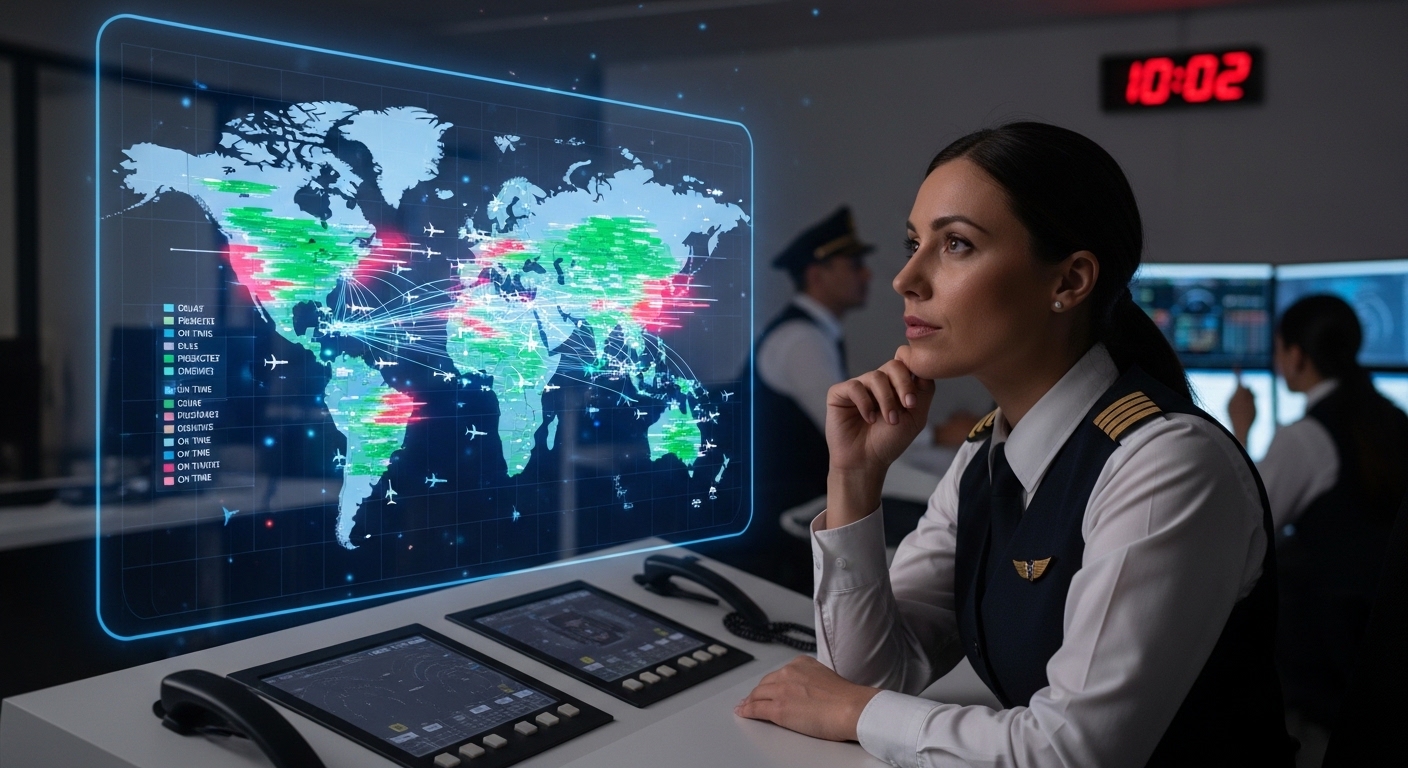
Flight delays are one of the most frustrating parts of air travel. But in 2026, airlines, airports, and flight-tracking apps now use AI-powered prediction systems to estimate delays before they happen. The question is:
How accurate are flight delay predictions really?
This complete guide explains how delay predictions work, what data they use, their accuracy, common failures, and how travelers can use them to plan smarter.
What Are Flight Delay Predictions?
Flight delay predictions are automated forecasts generated by airlines, airports, and flight-tracking platforms to estimate whether a flight will:
- Depart late
- Arrive late
- Be cancelled
- Be diverted
- Face ATC or weather restrictions
These predictions analyze historical data + real-time conditions using AI and machine learning.
How Modern Flight Delay Prediction Works
Today’s delay models use billions of data points. The most important include:
1. Historical On-Time Performance
- Seasonal patterns
- Airline punctuality
- Airport congestion cycles
2. Weather Forecasts
- Thunderstorms
- Winds
- Snow / visibility issues
- Jetstream patterns
3. ATC Restrictions (Ground Stops & Flow Programs)
If ATC limits traffic flow, delays become predictable.
4. Aircraft Location & Turnaround Time
If your incoming aircraft is delayed, your flight will be too.
5. Airport Traffic Levels
Busy hubs like JFK, LHR, DXB, and LAX have predictable congestion peaks.
6. Crew Duty Limits
If a delay pushes crew beyond legal limits, cancellations occur.
7. Maintenance Reports
Unexpected mechanical checks cause sudden delays.
8. Airline Network Behavior
Some airlines buffer their schedules more than others.
9. Global Disruptions
- Strikes
- Warzones
- Fuel shortages
- Airspace closures
AI combines all these signals to predict delay probabilities.
How Accurate Are Flight Delay Predictions?
Accuracy varies by platform and region. In 2026, most flight prediction systems achieve:
⦿ Short-term (0–3 hours before departure): 75–90% accuracy
Excellent when real-time conditions are known.
⦿ Medium-term (3–12 hours before departure): 55–70% accuracy
Useful but vulnerable to sudden weather or ATC changes.
⦿ Long-term (12+ hours in advance): 30–50% accuracy
These are rough estimates, not reliable forecasts.
⦿ Cancellations: 60–80% accuracy
Cancellations usually signal early through aircraft or crew data.
⦿ Airport-level predictions: 80%+ accuracy
Airport congestion patterns are consistent and easier to forecast.
Overall:
AI systems are accurate at spotting near-term operational risks, but long-term delays remain unpredictable.
Why Flight Delay Predictions Can Be Wrong
Even the best AI cannot predict sudden events such as:
1. Rapid Weather Changes
Storms can develop faster than forecast models update.
2. ATC Ground Stops
Unexpected staffing shortages or airspace closures cause sudden delays.
3. Last-Minute Mechanical Issues
A simple maintenance warning can delay a flight instantly.
4. Crew Duty-Time Expirations
If crew timeouts happen late, the system may not detect them early.
5. Tight Airline Schedules
Some airlines run aircraft so close to capacity that one disruption cascades unpredictably.
6. Geopolitical Events
- Military activity
- Airport security closures
- Unexpected diversions
These events are almost impossible to predict.
Which Flight Tracking Apps Have the Best Delay Predictions?
Accuracy varies by data access. Here’s a 2026 ranking:
1. FlightAware
Excellent predictive analytics + access to FAA data.
2. Flightradar24
Strong for global tracking + real-time delays.
3. FlightStats
Best for historical performance analysis.
4. Airline Apps
Most accurate for internal operational delays (crew, maintenance).
5. Google Flights
Uses machine learning + historical patterns.
6. Airport Apps
Best for gate changes and local delays.
The most accurate predictions combine multiple sources.
How Airlines Use Delay Predictions
Airlines rely on AI prediction engines to:
- Plan gate assignments
- Re-route aircraft
- Adjust crew schedules
- Apply buffer times
- Avoid cascading delays
- Improve on-time performance
Some airlines even use prediction models to prevent delays before they happen.
How Travelers Can Use Delay Predictions
✔ Check multiple flight trackers
Don’t rely on only one app.
✔ Watch your aircraft
Track the inbound flight—if it’s late, yours will be too.
✔ Understand weather risks
Storm seasons create predictable patterns.
✔ Monitor airport congestion
Certain hubs have premium vs. peak-hour delays.
✔ Turn on notifications
Real-time GSM + in-app alerts catch changes instantly.
✔ Book morning flights
They face fewer cascading delays.
Are AI Delay Predictions Getting Better?
Absolutely. 2026 systems use:
- Neural networks
- Deep learning
- Live ADS-B and satellite data
- Global weather models
- Airline operations data
- Machine-learning-powered optimization
By 2030, predictions may reach 95% accuracy within 3 hours of departure.
Frequently Asked Questions (FAQ)
Q1: How do apps predict flight delays?
They analyze weather, ATC data, aircraft location, airport congestion, and historical patterns using AI models.
Q2: Are airline apps more accurate than third-party apps?
Yes. Airlines have internal operational data (crew, maintenance) that others cannot access.
Q3: Can delays be predicted days before the flight?
Not reliably. Long-term predictions are only approximate.
Q4: Why do two apps show different predictions?
They use different data sources and algorithms.
Q5: Can flight delays be prevented?
Some can—airlines use prediction tools to avoid cascading delays, but weather and ATC disruptions remain uncontrollable.
Conclusion
Flight delay predictions in 2026 are more accurate than ever thanks to AI, big data, and global aviation connectivity. Short-term forecasts are highly reliable, while long-term predictions remain only partially accurate. Although sudden events can still cause surprises, delay forecasting is evolving fast and becoming a critical tool for travelers, airlines, airports, and aviation authorities.
Understanding how these predictions work—and when to trust them—helps passengers navigate disruptions smarter and travel with more confidence.
Leave a Reply