Tag: flight-tracking website

  • How Pilots Communicate: Inside ACARS

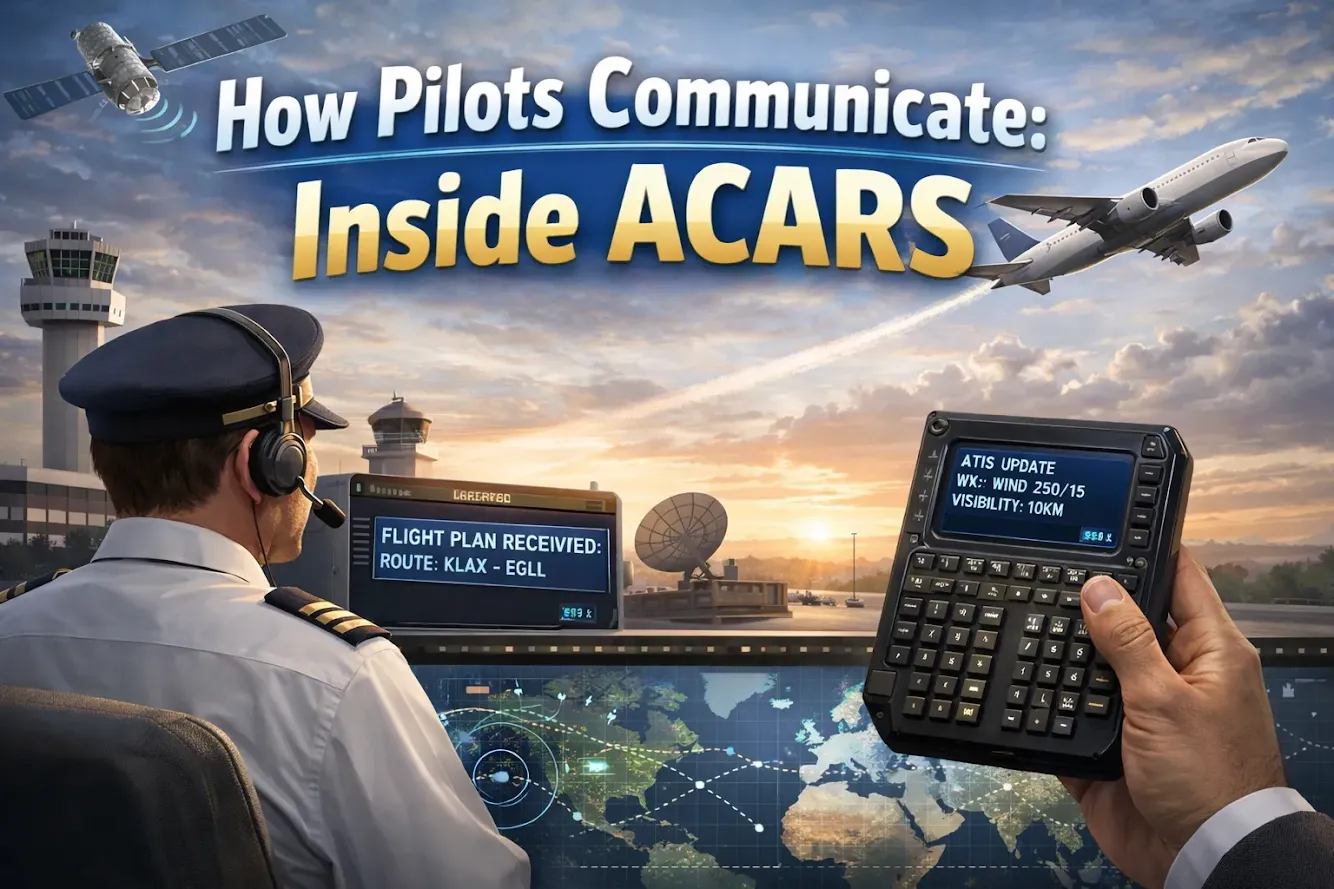
    How Pilots Communicate: Inside ACARS

    Introduction: The Hidden Messaging System of Aviation

    When most people think of pilot communication, they imagine radio calls like “Requesting clearance” or “Ready for takeoff.”
    But behind the scenes, hundreds of critical messages flow between aircraft and ground systems every minute — quietly, instantly, and digitally.

    This invisible network is called ACARS, and it’s one of the most important communication tools in modern aviation.
    ACARS helps pilots, dispatchers, and airlines share essential flight information without ever speaking over radio channels.

    In this guide, you’ll learn:

    • What ACARS is
    • How pilots use it
    • Why it transformed aviation
    • What messages does it send
    • How ACARS works behind the scenes
    • Its future in the age of satellites and AI

    What Is ACARS?

    ACARS (Aircraft Communications Addressing and Reporting System) is a digital communication system that sends short text messages between aircraft and ground facilities.

    Think of ACARS as aviation’s secure text-messaging network.

    It allows aircraft to automatically and manually send operational data — without radio congestion, voice misunderstandings, or human error.

    How ACARS Works 

    ACARS transfers data through three main channels:

    1. VHF Radio (Most Common)

    Used when the aircraft is near airports or flying over land.
    VHF ground stations receive messages and forward them to airline systems.

    2. HF Radio

    Used for long-range communications over oceans or remote regions where VHF doesn’t reach.

    3. Satellite Networks (Modern Standard)

    Aircraft send ACARS messages to satellites, which relay them to ground stations.
    This provides global coverage, even in the middle of the ocean.

    Together, these channels ensure an aircraft is always connected to the airline, even when radios are busy or unavailable.

    Why Pilots Use ACARS

    ACARS simplifies cockpit communication by automating routine tasks and reducing pilot workload.
    Instead of calling ATC or dispatchers for every update, pilots receive precise written messages directly on the cockpit screen.

    What pilots use ACARS for:

    • Getting weather updates
    • Receiving flight plans
    • Sending maintenance reports
    • Requesting takeoff numbers (TOW, FLEX, etc.)
    • Getting gate assignments
    • Sending “OUT/OFF/ON/IN” timestamps
    • Communicating with airline dispatch
    • Reporting system faults

    It reduces human error and ensures all messages are stored, time-stamped, and digitally verified.

    Types of ACARS Messages

    ACARS messages fall into three main categories:

    1. Operational Control (AOC) Messages

    These go between pilots and airline dispatchers.

    Examples:

    • Updated flight plan
    • Route changes
    • Fuel requests
    • Weather information
    • Alternate airport advice
    • Load sheet & weight updates

    2. Air Traffic Control (ATC) Messages

    Used for flight clearances or transition to CPDLC (Controller Pilot Data Link Communication).

    Examples:

    • Oceanic clearances
    • Level change requests
    • Altitude approvals
    • Direct routing instructions

    Digital messages reduce radio frequency congestion and eliminate ambiguous readbacks.

    3. Aircraft Health & Maintenance Reports

    Aircraft automatically send data to maintenance teams.

    Examples:

    • System faults
    • Engine performance data
    • Sensor warnings
    • Post-landing diagnostics

    This helps airlines predict problems before they ground an aircraft.

    What an ACARS Message Looks Like

    Most ACARS messages are short, code-like texts, for example:

    ACARS: WX REQUEST  

    ROUTE: DXB → LHR  

    ETA: 0942Z  

    TURBULENCE: MOD-SEV  

    Or a takeoff data request:

    REQUEST TOW + FLEX TEMP  

    RUNWAY 30R  

    WIND 280/08  

    These messages appear on the cockpit’s MCDU or dedicated ACARS screen.

    Why ACARS Changed Aviation Forever

    ACARS transformed aviation in several major ways:

    ✔ Increased Safety

    No misunderstandings from radio static or accents — messages are digital and verified.

    ✔ Lower Pilot Workload

    Routine tasks (weather, clearances, reports) are automated, not read over radio.

    ✔ Precise Tracking

    Dispatch knows the exact time a flight leaves the gate, takes off, lands, and arrives.

    ✔ Predictive Maintenance

    Aircraft send alerts before parts fail, reducing delays and cancellations.

    ✔ Better Long-Haul Communication

    Satellite ACARS allows stable communication over oceans and remote areas.

    ACARS vs Voice Radio: What’s the Difference?

    FeatureACARSVoice Radio
    AccuracyHigh (digital)Medium (human error)
    RangeGlobalLimited by radios
    CongestionLowHigh
    Message TypeText/dataVoice-only
    Use CaseRoutine ops, data exchangeUrgent or time-critical messages

    Pilots still use voice radio for emergencies, but ACARS handles the majority of routine communication.

    How Flight Tracking Apps Use ACARS

    Many popular tracking apps combine ADS-B + ACARS messages to give deeper insights, such as:

    • Estimated arrival times
    • Delay predictions
    • Diversions
    • Gate assignments
    • Airline messages

    ACARS is not primarily a tracking tool — but it enriches flight data significantly.

    The Future of ACARS (2025 and Beyond)

    A new generation called ACARS 2 / ATN B2 is emerging with:

    • Faster speeds
    • Secure digital encryption
    • Better integration with cockpit automation
    • More satellite coverage
    • AI-based maintenance alerts
    • Integration with future air traffic systems

    Within the next decade, ACARS will be part of a fully digital air traffic ecosystem.

    FAQs

    What do pilots use ACARS for?

    Pilots use ACARS to receive weather, flight plans, performance data, messages from dispatchers, and maintenance updates.

    Is ACARS the same as ATC communication?

    No. ACARS is for data messaging, while radio/CPDLC is for ATC instructions. They work together.

    Do all aircraft use ACARS?

    Most commercial aircraft do. Some smaller private planes may not have ACARS installed.

    Can the public see ACARS messages?

    Some ACARS data can be captured via receivers, but sensitive messages are encrypted or restricted.

    Is ACARS going away?

    No — it’s evolving. Newer digital data link systems are being built on top of ACARS infrastructure.

    Conclusion

    ACARS is the quiet, digital backbone of modern aircraft communication.
    It keeps pilots connected, automates routine tasks, reduces errors, and ensures aircraft stay safe and efficient worldwide.

    From flight plans to weather to maintenance messages, ACARS proves that aviation runs on far more than just radios — it runs on data.

  • Most Tracked Right Now: Live Flight Stories

    Most Tracked Right Now: Live Flight Stories

    Every day, thousands of flights circle the globe – but at any given moment, only a handful become the center of global attention. These are the flights labeled as “Most Tracked” on live‑flight radar services. This article explores what that means, why some flights draw massive interest, and what kind of “live flight stories” people follow.

    What Does “Most Tracked Right Now” Mean?

    When a flight tracking website or app (like Flightradar24, FlightAware, RadarBox or other radar‑tracker services) marks a flight as “Most Tracked,” it means:

    • A very large number of users are monitoring that flight’s progress live — more than typical flights.
    • People have likely flagged or “pinned” that flight on their trackers or are refreshed to watch its position or status.
    • Often the flight has something that makes it interesting: unusual route, emergency, special passengers, or just curiosity.

    So “Most Tracked” doesn’t necessarily mean “most passengers,” but “most people paying attention to it online.”

    Why Some Flights Get Heavy Tracking

    There are a few common reasons certain flights attract huge attention and become “live flight stories.”

    1. Breaking News / Emergency / Unusual Flight

    If a flight becomes newsworthy — a rescue mission, emergency landing, VIP transport — many users open their trackers simultaneously. This surge in viewers pushes it to “Most Tracked.”

    2. Celebrity / High-profile Passengers or Private Jets

    Flights carrying famous people or important figures often draw attention. People log in to see where the aircraft is, where it lands, etc.

    3. Rare or Interesting Route — Long‑haul, Charter, or Special Route

    Sometimes a rare route or charter — perhaps repatriation, humanitarian flight, odd route due to weather or restrictions — draws watchers.

    4. Aviation Hobbyists and Enthusiasts

    Plane‑spotters, aviation‑enthusiasts or “avgeeks” often track interesting aircraft types, new liveries, or uncommon flights. If a rare aircraft type or new livery is in the sky, many track it live.

    5. Family / Friends Following a Flight

    Passengers, their families or friends often track flights of loved ones — especially when landing or takeoff time matters.

    Examples & What Live Flight Stories Look Like

    • A charter flight carrying a sports team, celebrity, or VIP — thousands log on just to watch.
    • A humanitarian or medevac flight going over a crisis area gets lots of attention from media, watchers, and concerned followers.
    • Rare aircraft type or livery flying a commercial route — attracts plane‑spotters.
    • Flight delay or diversion stories — flights that deviate from plan, get diverted, or route changes become “watch‑worthy.”
    • Regular flights, but with curiosity: sometimes even standard scheduled flights get many watchers (for reasons like curious admirers, people living under the flight path, etc.).

    What “Live Flight Stories” Tell Us?

    Live flight tracking and “most tracked” lists give some interesting insights:

    • Human curiosity & empathy: People want to know where a flight is, especially if someone they know is on board.
    • Global connectivity: A flight over one region can get tracked globally — showing how interconnected we are.
    • Transparency & accessibility: Anyone with internet can see what’s up in the skies — democratizing what once was privileged data.
    • Aviation interest & hobby culture: Plane‑spotting, tracking unusual aircraft or flights, and sharing live data — a growing community and culture.

    What to Do If You Want to Track “Live Flight Stories”

    If you want to follow flights live or jump on trending flights:

    1. Use a trusted flight‑tracking service or app (Flightradar24, FlightAware, RadarBox, etc.)
    2. Use search options: flight number, route, airline, or even airport, or just scan the live map for flights in your area.
    3. Watch for flights marked “most tracked” — those are likely interesting or currently trending.
    4. Enable alerts/notifications if available — for departure, arrivals, route changes, delays.

    Conclusion

    The “Most Tracked Right Now” feature on flight-tracking platforms provides a fascinating glimpse into what captures global attention in real time. Whether it’s an emergency flight, a VIP jet, or an unusual route, these live flight stories show how technology connects us to the skies like never before.

    For aviation enthusiasts, travelers, or curious viewers, live flight tracking is not just about seeing planes on a map — it’s about following stories as they unfold in the air. 

    FAQs

    Q: What does “Most Tracked Right Now” mean?

    A: It indicates flights that have the highest number of live viewers on tracking apps or websites at that moment.

    Q: Why do some flights get more tracked than others?

    A: Flights become highly tracked due to VIP passengers, unusual routes, emergencies, rare aircraft types, or popular events.

    Q: Which platforms show “Most Tracked” flights?

    A: Apps like Flightradar24, FlightAware, and RadarBox highlight currently trending or most-watched flights.

    Q: Can anyone track these flights live?

    A: Yes. Any user with an internet connection can use these apps to follow live flights in real time.

    Q: Do commercial flights often appear as “most tracked”?

    A: Sometimes. While most tracked flights often involve unusual events or VIP passengers, popular domestic or high-profile flights can also appear.