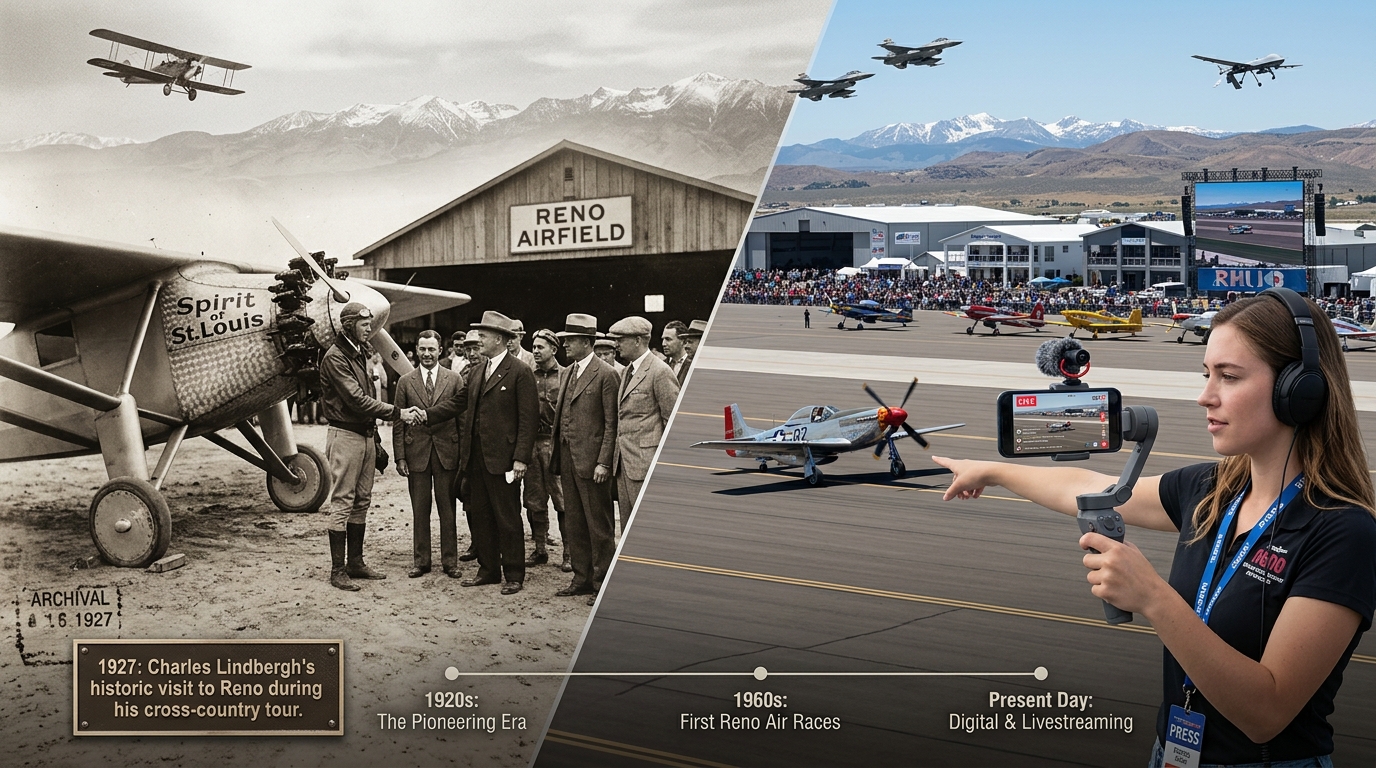
Reno-Tahoe International Airport (RNO) is one of the most quietly historic airports in the American West. What began as a rough, unpaved landing strip nearly a hundred years ago has grown into a modern gateway handling hundreds of daily operations — and today, thanks to always-on flight tracking cameras and live streaming feeds, anyone in the world can watch its runways in real time. Here’s how Reno’s airport got from a near-disaster involving one of aviation’s most famous pilots to the 24/7 digital window it is today.
A Rocky Start: Charles Lindbergh and Blanch Field
Reno’s aviation story starts in 1927, and it almost ended before it began. That September, Charles Lindbergh — fresh off his historic transatlantic crossing — landed the Spirit of St. Louis at Reno’s original airstrip, known at the time as Blanch Field. The landing was dangerously close to disaster: Lindbergh nearly collided with parked cars and other obstacles scattered around the unregulated field.
Rather than staying quiet about it, Lindbergh went public. He declared the airfield unsafe and called for serious changes if Reno wanted to be taken seriously as an aviation stop. That warning from one of the most famous aviators alive didn’t go unnoticed.
Hubbard Field: Reno’s First Real Airport
Boeing Transport Inc. responded to Lindbergh’s warning by purchasing roughly 120 acres of land just east of Blanch Field in 1928, intending to build a proper, functional airfield — one designed from the ground up to support airmail operations and future passenger service. Construction wrapped up in 1929, and the new facility opened under the name Hubbard Field.
United Airlines ran the airport for its early years before ownership transferred to the City of Reno, converting it into a municipal airport. It briefly took on a very different role during World War II, serving as a U.S. Air Force base before returning to civilian use.
The 1960s: Olympics, Runways, and Reno’s First Jet
Reno’s airport took its first major leap forward in the late 1950s with the construction of a new passenger terminal, timed to support the 1960 Winter Olympics held in nearby Squaw Valley, California. Because Squaw Valley itself had minimal infrastructure at the time, Reno effectively became the region’s primary aviation hub for the Games — a role that pushed the airport to modernize its terminal, check-in areas, and baggage handling almost overnight.
The bigger milestone came a few years later. In June 1964, United Airlines flew Reno’s first-ever jet service using a brand-new Boeing 727-100. That flight was only possible because the airport had extended its main runway from roughly 7,800 feet to about 9,000 feet — a jump of nearly 2,300 to 2,750 meters — giving jets the length they needed to operate safely.
Jet service opened the door to longer, more valuable routes. Early jet flights connected Reno to San Francisco, with domestic routes to Los Angeles, Chicago, and Denver following later in the decade. By April 1968, Reno added another aircraft type to its lineup with its first scheduled Boeing 737-200 flight, again operated by United.
A New Name, Twice: Cannon International to Reno-Tahoe
In 1977, the airport was renamed Cannon International Airport, honoring U.S. Senator Howard Cannon for his role in advancing commercial aviation policy. That name stuck for nearly two decades until 1994, when the airport authority rebranded it once more — this time as Reno-Tahoe International Airport, a name chosen deliberately to connect the airport with the globally recognized Lake Tahoe tourism brand nearby.
Terminal expansion continued through this era as well. In the early 1980s, two satellite concourses — Concourse B and Concourse C — were added and remain in active use today. Between them, the airport now operates 23 jet bridges, along with additional remote aircraft parking. A dedicated international arrivals terminal followed in the late 1990s, rounding out Reno’s transformation into a fully modern regional airport.
The Next Chapter: A $650 Million Terminal Overhaul
Reno-Tahoe International Airport isn’t finished growing. In March 2026, airport officials announced one of the most significant projects in the facility’s history: two brand-new concourses — Concourse A and Concourse B — being built at a cost of $650 million, set to replace the current terminal infrastructure starting in 2028 and 2029.
The scale of the project is substantial. Total concourse space is expected to nearly double, growing from 130,000 square feet per concourse to 250,000 square feet. The plan also adds 24 new jet bridges built to accommodate larger next-generation aircraft, including the Boeing 737 MAX 10, along with expanded passenger amenities throughout.
Reno-Tahoe Airport Today: By the Numbers
Modern-day RNO handles a busy, diverse mix of traffic. On a typical day, the airport supports around 160 arrivals and departures combining commercial flights, cargo operations, and general aviation activity such as private jets and flight training. Over any given week, that adds up to roughly 2,300 total operations — an even split of about 1,150 arrivals and 1,150 departures.
The airport operates three runways of varying length:
- Runway 17R-35L — the primary runway at approximately 11,000 feet (3,353 meters), carrying the majority of traffic — roughly 76% of weekly operations
- Runway 17L-35R — a secondary runway at about 2,743 meters, handling around 20% of operations
- Runway 08-26 — the shortest of the three at roughly 1,860 meters, used for the remaining traffic
Reno’s busiest passenger routes connect it to major western hubs. Las Vegas, Denver, and Los Angeles top the list with 86, 55, and 53 weekly flights respectively. Rounding out the top ten are Phoenix, San Francisco, San Diego, Salt Lake City, Seattle, Dallas, and Portland. On the freight side, cargo carriers including Kalitta Air, FedEx, and UPS keep goods moving through Reno, with FedEx and UPS regularly running wide-body aircraft into the airport.
Southwest Airlines currently leads the field among passenger airlines operating at Reno, running about 175 flights a week across eight different routes. Other major carriers serving RNO include Alaska Airlines, American Airlines, Delta Air Lines, Frontier, jetBlue, JSX, Sun Country, United Airlines, and Mexico’s Volaris — the only non-U.S. carrier on the list.
Watching Reno’s Runways in Real Time
What makes Reno’s story especially fitting for the modern aviation world is how easily it can now be observed. Automated airport livestream cameras capture continuous footage of takeoffs and landings around the clock — passenger jets, cargo freighters, and general aviation traffic alike — turning an airport once nearly wrecked by an unregulated field into one of the most watchable in the country. It’s a fitting bookend: from a pilot warning that Reno’s airfield wasn’t safe enough to fly into, to a facility now open for the whole world to watch, any hour of the day.
The Bigger Picture
Reno’s evolution — from Blanch Field’s near-disaster to a $650 million terminal expansion less than a century later — mirrors the broader story of American regional aviation: modest beginnings, decades of steady infrastructure investment, and a constant push to keep pace with bigger aircraft and busier skies. For an airport that almost didn’t survive its first brush with a famous aviator, Reno-Tahoe International has built a remarkably resilient legacy — and its next chapter, arriving in 2028, is already underway.
Leave a Reply