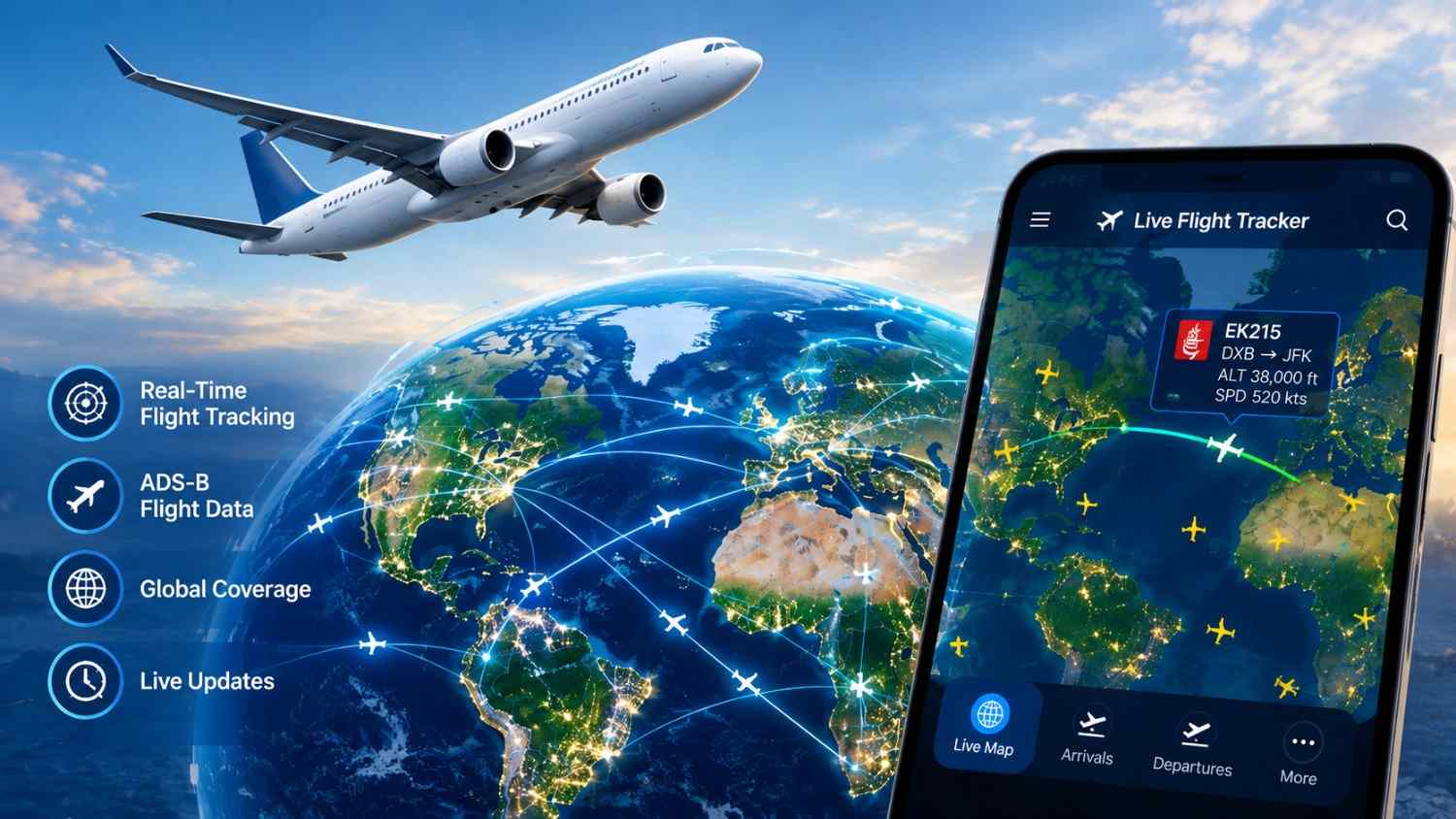
Have you ever looked up at a plane crossing the sky and wondered where it came from and where it’s going? Or stood at an airport arrivals gate checking your phone for a delayed flight? A live flight tracker online answers these questions in seconds. You can see every aircraft in the sky, its speed, altitude, route, and estimated arrival time, all updating in real time.
This guide explains how real-time flight tracking works, what ADS-B data is, which features matter most, and how to track a flight live from your phone or computer.
What Is a Real-Time Flight Tracker?
A real time flight tracker is a website or app that shows the current position of aircraft on a map. Most display a small plane icon that moves across the screen as the real aircraft moves through the sky. Tap or click an icon and you’ll see details such as:
- Flight number and airline
- Departure and arrival airports
- Aircraft type and registration
- Current altitude and ground speed
- Scheduled and estimated arrival times
- Flight path history
Travelers use these tools to monitor loved ones’ flights, plan airport pickups, and check for delays. Aviation enthusiasts use them for plane spotting, and journalists and researchers use them to follow aircraft movements.
How Live Airplane Tracking Works: ADS-B Explained
Most modern live airplane tracker platforms rely on ADS-B, short for Automatic Dependent Surveillance-Broadcast. It’s the backbone of real-time aircraft tracking.
An ADS-B-equipped aircraft uses satellite navigation, typically GPS, to work out its exact position. Its transponder then broadcasts that position, along with altitude, speed, heading, and an identification code, about once per second. Ground-based receivers pick up these signals, and the tracking platform plots them on a map.
Thousands of volunteer-operated receivers around the world, many run by aviation hobbyists, form a network that feeds data into flight tracking platforms. That’s why coverage is strongest over populated land areas with many receivers.
Other Data Sources
ADS-B isn’t the only source behind a real time airplane tracking system. Platforms often combine several:
- MLAT (multilateration): Calculates the position of aircraft with older transponders by measuring signal arrival times at several receivers.
- Satellite-based ADS-B: Space-based receivers fill the gaps over oceans and remote regions, where ground coverage is limited.
- Airline and airport schedules: These supply departure times, gates, and estimated arrivals.
- Air traffic control feeds: Some regions share radar-derived data, which helps in areas with limited ADS-B coverage.
Combining these sources gives you a more complete picture, especially when you want to track international flights live across oceans.
Key Features of a Great Live Flight Tracker
Not every tracker is equally useful. Here’s what to look for when choosing one.
1. A Responsive Live Map
The best flight tracking live map is smooth, easy to zoom, and lets you filter by airline, altitude, aircraft type, or airport. A clean interface matters most when thousands of planes are on screen at once, as they are over Europe or North America during peak hours.
2. Accurate Flight Status
A good live flight status tracker goes beyond the dot on the map. It should tell you whether a flight is scheduled, departed, en route, landed, delayed, or diverted, and update the estimated arrival time as conditions change.
3. Arrivals and Departures Boards
A flight tracker for arrivals and departures lets you search by airport and see everything coming in and going out. This is ideal if you’re picking someone up and want to know exactly when to leave for the airport.
4. Notifications and Alerts
Push notifications for gate changes, delays, takeoffs, and landings save you from refreshing the page. Many apps let you follow a specific flight and get alerts automatically.
5. Historical Flight Data
Looking at a flight’s past route and performance helps you judge how reliable it is. Some platforms keep records for days, months, or longer, though longer history is often a paid feature.
6. Global Coverage
If you travel internationally, make sure the tracker has strong coverage in the regions you care about. Receiver density varies by country, so test it on routes you know.
Best Flight Tracker Apps and Websites
Several well-known platforms dominate the space. Features and pricing change often, so check each one’s current offering before committing.
Flightradar24 is one of the most popular choices, known for its polished map, large receiver network, and detailed aircraft information. It has a free tier and paid subscription plans with extras like longer history and advanced filters.
FlightAware is strong on flight status, airport boards, and airline operations data. It’s widely used by both travelers and aviation professionals.
ADS-B Exchange focuses on unfiltered ADS-B data, which makes it popular with researchers and enthusiasts who want a less filtered view of global traffic.
Plane Finder offers a clean mobile experience and features aimed at aviation fans, including augmented reality options in its app.
RadarBox provides live maps with global coverage and a range of data tools for both casual users and professionals.
Most of these platforms offer a flight tracking app free to start, usually with ads or limited features, and unlock more with a paid plan. For casual use, a free version is usually plenty.
How to Track a Flight in Real Time
Wondering how to track a flight in real time? The process is simple on any platform.
Step 1: Choose your tracker. Open a flight tracking website or download an app.
Step 2: Search for your flight. Enter the flight number, such as the airline code followed by digits. You can also search by route, airport, airline, or aircraft registration.
Step 3: Open the live map. Select your flight from the results to see its position, altitude, speed, and projected path.
Step 4: Check the status details. Look at the departure and arrival times, terminal and gate information, and any delay notes.
Step 5: Turn on alerts. If you’re using an app, follow the flight so you get automatic updates.
Pro tip: If you can’t find a flight, it may not have departed yet. Many trackers only show a flight on the map once the aircraft is airborne or about to push back from the gate.
Live Flight Tracker Apps: Download and Setup Tips
If you’re ready for a live flight tracker app download, here’s how to get set up quickly:
- Open the App Store or Google Play and search for your chosen tracker.
- Download the official app and check the publisher name to avoid imitations.
- Allow notifications so you receive flight alerts.
- Save your frequent routes or follow your upcoming trips.
- Explore the filters and map layers, such as weather, to get more value from the app.
An airplane tracker app is also handy for spotting planes overhead. Many apps let you point your phone at the sky to identify a plane’s flight number and destination.
Real-World Uses for Flight Tracking Data
Real-time tracking is useful well beyond curiosity.
Travelers and families: Know exactly when a relative’s flight will land, so you’re not waiting at the airport longer than necessary.
Business professionals: Monitor flights for meetings, shipments, and corporate travel.
Aviation enthusiasts: Follow rare aircraft, airline livery changes, and special flights.
Students and educators: Explore geography, physics, and air traffic management using live data.
Journalists and researchers: Follow aircraft movements during news events and study air traffic patterns.
Understanding the Limits of Live Tracking
Flight trackers are powerful, but they aren’t perfect. Keep these limits in mind:
- Coverage gaps: Remote areas and oceans may have little or no real-time data, depending on satellite coverage.
- Data delays: Some platforms add a short delay, and free versions may refresh less often.
- Blocked or limited aircraft: Certain aircraft, including some government and military flights, may not appear or may be filtered for privacy or security reasons.
- Estimated times: Arrival estimates are projections and can change with weather, air traffic, and routing.
For decisions that really matter, like rebooking a connection, always confirm with your airline as well.
Tips for Getting the Most From Your Flight Tracker
- Zoom to your airport to see arrivals and departures in a single view.
- Use filters to narrow the map to specific airlines or aircraft types.
- Check the inbound aircraft. If the plane for your flight is arriving late from a previous leg, a delay is likely.
- Compare two sources if the data looks inconsistent.
- Use dark mode or night view for easier reading in low light.
The Future of Global Flight Tracking
Flight tracking keeps improving. Space-based ADS-B has expanded coverage over oceans, and better data processing makes arrival predictions more accurate. Receiver networks keep growing as more hobbyists join, and apps are adding richer layers such as weather, turbulence, and airport conditions. In the coming years, expect even more precise estimates and smoother global coverage.
Final Thoughts
Whether you want to check a loved one’s arrival, satisfy your curiosity about a plane overhead, or dig into aviation data, a live flight tracker puts the world’s skies at your fingertips. Understanding how ADS-B and complementary data sources work helps you read the map with confidence, and choosing a tracker with a responsive live map, accurate flight status, and useful alerts makes the experience better.
Start with a free app, track a flight you know, and explore from there. Once you see how much is happening in the sky at any moment, you may never look up at a plane the same way again.
FAQ
Is flight tracking legal?
Yes. ADS-B signals are broadcast openly, and tracking aircraft using public data is legal in most places. Some aircraft may be hidden from public view for security or privacy reasons.
Are live flight trackers free?
Many offer free versions with core features. Premium plans typically add longer history, advanced filters, and an ad-free experience.
How accurate is real-time flight tracking?
Position data is generally very accurate where receiver or satellite coverage exists. Arrival time estimates are projections and can change.
Can I track a flight before it takes off?
You can usually view scheduled status, gate details, and inbound aircraft information. The live position appears once the aircraft is moving or airborne.
Leave a Reply