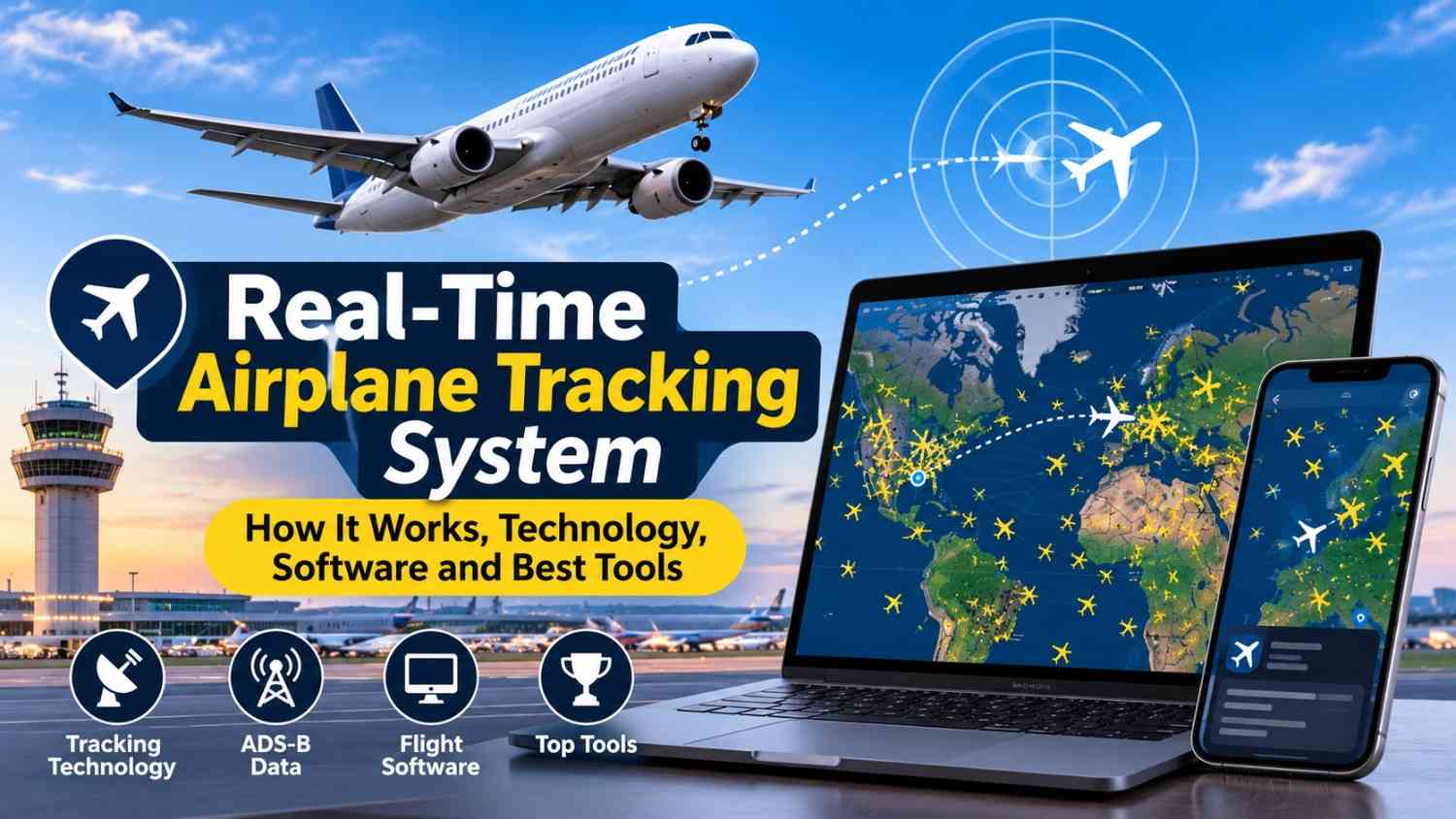
Have you ever watched a plane cross the sky and wondered where it came from and where it is going? Today, you can answer that in seconds. A real-time airplane tracking system shows the exact position of thousands of aircraft on a live map, along with their speed, altitude, heading and route.
Airlines, airports, aviation businesses, logistics companies and everyday travelers all rely on live airplane tracking to stay informed. In this guide, you will learn what a real-time airplane tracking system is, how it works, which technologies power it, how accurate it is, and how to choose the best flight tracking software for your needs.
What Is a Real-Time Airplane Tracking System?
A real-time airplane tracking system is a combination of hardware, data networks and software that collects an aircraft’s position and flight data and displays it almost instantly on a map. Instead of waiting for updates, you see where an aircraft is right now.
A typical live aircraft tracking platform shows:
- Current latitude and longitude (airplane location tracking)
- Aircraft speed and altitude
- Heading and vertical rate
- Flight number and aircraft identification
- Departure and arrival airports
- Estimated arrival time
- Flight path history
These systems are also called an aircraft tracking system, an online flight tracker, or a flight radar tracking system, depending on the provider and the use case.
How Does a Real-Time Airplane Tracking System Work?
The process can be broken into four simple stages:
- Data transmission: The aircraft broadcasts its identity and position using onboard equipment such as a transponder.
- Data reception: Ground receivers, satellites or radar stations pick up those signals.
- Data processing: Servers combine, clean and validate the data from many sources, which supports flight data monitoring and aviation data analytics.
- Data display: The processed aircraft position updates appear on a website, mobile app or dashboard as moving icons on a map.
Because this chain works in seconds, the map you see is a near-live picture of the sky.
How ADS-B Aircraft Tracking Works
Automatic Dependent Surveillance-Broadcast (ADS-B) is the backbone of modern real-time flight tracking.
Here is how it works:
- The aircraft determines its position using satellite navigation (GPS-based aircraft tracking).
- Its aircraft transponder data broadcasts that position, together with identification, altitude, speed and heading, roughly once per second.
- Ground-based ADS-B receivers, other aircraft, and in some cases satellites receive the broadcast.
- A tracking network collects these messages and sends them to servers and maps.
ADS-B is called “automatic” because no pilot input is needed, and “dependent” because it depends on the aircraft’s own navigation data. Many regions, including the United States and Europe, require ADS-B equipment on aircraft flying in most controlled airspace, which is why coverage on commercial flights is so strong.
MLAT and Radar Support
When an aircraft does not broadcast ADS-B, some networks use multilateration (MLAT). Several receivers measure tiny differences in signal arrival time to estimate the aircraft’s position. Traditional radar also remains an important part of air traffic control systems.
Satellite Coverage
Ground receivers cannot cover oceans or remote regions. Space-based ADS-B receivers fill those gaps, giving global flight tracking system coverage on long-haul routes.
Technologies Used in Aircraft Tracking
If you are asking, “What technology is used for aircraft tracking?”, these are the main components:
| Technology | What It Does |
| ADS-B | Broadcasts position, speed, altitude and identity |
| GPS / GNSS | Provides precise aircraft GPS tracking |
| Mode S transponders | Share aircraft identification and altitude |
| MLAT | Estimates position when ADS-B is unavailable |
| Primary and secondary radar | Used by air traffic control for air traffic monitoring system needs |
| Satellite ADS-B | Extends coverage over oceans and poles |
| ACARS and datalink | Send operational messages between aircraft and airlines |
| Cloud servers and APIs | Process and deliver live flight information |
Together, these form modern aviation surveillance technology and flight tracking technology.
Key Features of Flight Tracking Software
Not all flight tracking software is equal. Whether you want an online flight tracker for personal use or a platform for your business, look for these features:
- Live map view with smooth aircraft movement
- Search by flight number, airline, registration or airport
- Flight path visualization with historical routes
- Aircraft speed and altitude details
- Live flight status tracker with delays, gates and arrival estimates
- Alerts and notifications for departures, landings and delays
- Weather and airspace layers
- Filters for aircraft type, airline or altitude
- Analytics dashboards for aviation data analytics
- API access for developers and businesses
- Mobile apps for iOS and Android
For aviation businesses, features such as fleet monitoring, geofencing and exportable reports are especially valuable.
How to Track Airplanes Live on a Map
Tracking a flight is simple:
- Open a trusted online flight tracker or flight radar tracking system.
- Allow the map to load live aircraft icons.
- Search by flight number, airline, airport or aircraft registration.
- Click the aircraft to view its altitude, speed, route and estimated arrival time.
- Turn on route or weather layers for additional detail.
- Set alerts if you want updates sent to your phone.
This is the easiest way to see live airplane tracking whether you are waiting for a relative at the airport or simply watching global air traffic.
Can You Track an Aircraft Using Its Flight Number?
Yes. Live airplane tracking with flight number is one of the most popular uses. Enter the airline code and number (for example, an airline’s two-letter code followed by digits) into a flight tracker. The system matches it with the aircraft currently operating that flight and shows its position, status and flight route monitoring details.
A few tips:
- Use the correct airline code and number printed on your ticket.
- If the flight has not departed yet, you will usually see its scheduled status and the previous inbound aircraft.
- Codeshare flights may have a different number than the operating airline’s flight.
Real-Time Flight Tracking API Integration
If you are a developer, travel company or airline partner, a real-time flight information API lets you add live tracking to your own app or website.
A good real-time flight tracking API typically provides:
- Live aircraft positions and aircraft identification
- Flight schedules, delays and cancellations
- Airport and airline data
- Historical flight data for analytics
- Webhooks or streaming for instant updates
Integration Steps
- Choose an API provider that matches your coverage and budget.
- Get your API key and review the documentation.
- Request flight or aircraft data in JSON format.
- Display positions with a mapping library.
- Cache responses and respect rate limits to keep costs down.
- Add error handling for missing or delayed data.
This approach is ideal for aircraft tracking system for aviation businesses, logistics platforms, travel apps and airport information displays.
Benefits for Airlines and Aviation Businesses
Real-time aircraft tracking for airlines and related companies provides strong operational value:
- Better fleet visibility: Know where every aircraft is at any moment.
- Improved on-time performance: Spot delays early and adjust turnaround plans.
- Customer communication: Send accurate arrival updates to passengers.
- Safety and compliance: Support real-time aircraft monitoring and incident response.
- Fuel and route efficiency: Review flight route monitoring data to improve planning.
- Data-driven decisions: Use aviation data analytics to study trends in delays, routes and performance.
Airports, ground handlers, cargo firms and charter operators gain similar advantages.
How Accurate Are Live Airplane Tracking Systems?
Accuracy is usually very good for commercial aircraft tracking, but several factors matter:
- Source of data: ADS-B based on GPS is generally precise, often within a few meters.
- Receiver coverage: Ground receivers work by line of sight, so low-altitude aircraft in remote areas may disappear from the map.
- Update frequency: ADS-B messages are frequent, but some websites show data with a short delay of a few seconds to a minute.
- MLAT and estimated positions: These can be less precise than direct ADS-B data.
- Filtered aircraft: Some military or sensitive flights may be limited or hidden from public trackers.
In short, public trackers are highly reliable for airline flights but should not replace official air traffic control information for safety-critical decisions.
Is Real-Time Flight Tracking Free?
Many platforms offer a free online airplane tracking system with basic features such as live maps, flight search and arrival times. Paid plans typically add:
- Extended flight history
- Advanced filters and alerts
- Ad-free viewing
- Weather and airspace layers
- Higher data limits and API access
- Business and enterprise dashboards
For casual use, free tools are usually enough. For airlines, aviation businesses and developers, a paid plan or commercial API is a better choice.
Best Practices When Choosing a Tracking Solution
When comparing the best real-time aircraft tracking software, ask these questions:
- Coverage: Does it include satellite, ground and MLAT data for global reach?
- Latency: How quickly does it refresh positions?
- Data depth: Does it show speed, altitude, route, aircraft type and history?
- Reliability: Is uptime high, and is the data source transparent?
- Integration: Is there a well-documented API?
- Scalability: Can it support many users or aircraft?
- Security and privacy: Does it follow data protection rules?
- Cost: Does the pricing fit your usage?
The Future of Flight Tracking Technology
Aircraft tracking is evolving quickly. Expect to see:
- Wider satellite coverage for true global aviation tracking
- AI-powered delay prediction and route optimization
- Richer flight path visualization in 3D
- Integration with airport systems, weather and drone traffic management
- Faster, more accurate aircraft position updates
As these improvements arrive, a real-time airplane tracking system will become even more useful for safety, planning and passenger experience.
Conclusion
A real-time airplane tracking system brings together ADS-B, GPS, radar, satellites, cloud servers and user-friendly software to show where aircraft are right now. From travelers checking a live flight status tracker to airlines managing fleets and developers using a real-time flight tracking API, this technology makes aviation more transparent, efficient and safe.
If you want to explore it, start with a free online flight tracker. If you are building a business solution, choose flight tracking software with strong coverage, reliable data and flexible API integration.
Ready to start tracking? Pick a trusted platform, search your flight number, and watch the sky in real time.
Frequently Asked Questions
What is a real-time airplane tracking system?
It is a system that collects aircraft position and flight data from transponders, GPS, ADS-B receivers, radar and satellites, then displays it live on a map or dashboard.
How can I track an airplane in real time?
Open an online flight tracker, search by flight number, airline or airport, and select the aircraft on the map to see its live location, speed, altitude and route.
How accurate are live airplane tracking systems?
They are very accurate for commercial flights because they rely on GPS-based ADS-B data. Accuracy can drop in areas with limited receiver coverage or when positions are estimated using MLAT.
Can I track an aircraft using its flight number?
Yes. Enter the airline code and flight number into a flight tracker to view the aircraft’s current position, status and estimated arrival.
What technology is used for aircraft tracking?
Common technologies include ADS-B, GPS, Mode S transponders, MLAT, radar, satellite receivers, ACARS and cloud-based software with APIs.
Is real-time flight tracking free?
Basic tracking is free on many websites and apps. Advanced features, historical data and API access are usually part of paid plans.
How does ADS-B tracking work?
An aircraft uses GPS to find its position, then broadcasts that position and identification data about once per second. Ground stations or satellites receive the signal and send it to tracking servers, where it appears on a live map.
Leave a Reply