Author: 12d

  • How to Track International Flights Live Using the Best Flight Tracker Tools

    How to Track International Flights Live Using the Best Flight Tracker Tools

    Tracking a domestic flight is usually simple: pull up a flight tracker, search the flight number, and watch the dot move across the map without much drama. International flights are a different story. Long-haul routes cross oceans, multiple time zones, and regions with inconsistent tracking coverage which means the same basic process can produce confusing results if you don’t understand what’s actually happening behind that moving dot.

    This guide focuses specifically on tracking international flights live: how the technology handles long-haul and cross-ocean routes, which tools handle worldwide coverage best, and the practical adjustments that make tracking an overseas flight far less confusing.

    Why Tracking International Flights Is Genuinely Different

    Before comparing tools, it’s worth understanding why international tracking behaves differently than a short domestic hop.

    • Longer routes cross more airspace jurisdictions, each with different levels of ground-based tracking infrastructure.
    • Ocean crossings remove ground coverage entirely for stretches of the flight, requiring satellite-based tracking to fill the gap.
    • Time zone changes multiply confusion, since a flight departing at 11 p.m. one day might land at 6 a.m. two calendar days later from the traveler’s perspective, even though the actual flight time was far shorter.
    • Code-share flights complicate flight number searches, since an international flight is often sold under multiple airline codes for the same physical aircraft, and tracking the “wrong” flight number can show inconsistent information.

    None of this makes international tracking unreliable it just means understanding a few extra variables makes the whole process much less confusing.

    How Real-Time International Flight Tracking Actually Works

    A real time airplane tracking system for international routes typically blends three underlying data sources, each covering a different gap in coverage.

    ADS-B ground stations

    Most modern aircraft broadcast ADS-B signals GPS-based position, altitude, and speed data picked up by ground receivers within range. This works extremely well over land, especially in regions with dense receiver networks, which is why a flight radar live view usually looks smooth and continuous while a flight is over populated continents.

    Satellite-based ADS-B

    Once a flight moves beyond ground receiver range over an ocean, for example many modern tracking platforms switch to satellite-based ADS-B, picking up the same broadcast signal from orbit instead of the ground. This is what allows a capable live air traffic tracker to maintain reasonably continuous coverage even across the Atlantic or Pacific, though update frequency can be slightly less frequent than dense ground coverage provides.

    Multilateration

    In regions with partial ground coverage enough receivers to detect a signal, but not precisely enough for full ADS-B accuracy some systems use multilateration, triangulating an aircraft’s position using the timing differences between multiple receivers picking up the same signal. This fills in some of the middle ground between full ADS-B coverage and total data gaps.

    Airline and airport schedule data

    Layered on top of all this positional data is standard schedule information from airlines and airports gate assignments, scheduled versus actual departure and arrival times, and delay status. This is what turns a raw moving dot into a complete live flight status tracker experience.

    Step-by-Step: How to Track an International Flight Live

    Step 1: Get the correct flight number

    International flights are frequently sold under multiple airline codes through code-share agreements. If you search a flight number and the results look inconsistent with what you expect, double-check whether you have the operating airline’s flight number or a code-share partner’s number they can refer to the exact same physical flight but return different-looking data depending on the tracker.

    Step 2: Search using a live flight tracker online

    Use a live flight tracker online tool and search by flight number, or by route and approximate departure time if you don’t have the exact number. Look for a result showing the correct departure and arrival airports to confirm you’ve found the right flight, especially for airlines with multiple daily flights on the same route.

    Step 3: Confirm the time zone being displayed

    This is the single most common source of confusion for international tracking. Before assuming a flight is delayed or behaving unexpectedly, confirm whether the departure and arrival times shown are in local departure time, local arrival time, or your own device’s time zone many tracking platforms let you toggle this, and it’s worth checking explicitly rather than assuming.

    Step 4: Switch to the live map to track flight live

    Once the flight is airborne, switch to the live map view to track flight live as it crosses regions. Expect the aircraft icon to move smoothly over land and potentially update less frequently mid-ocean this is normal behavior tied to the underlying tracking technology, not a malfunction.

    Step 5: Watch for expected coverage gaps

    If the aircraft briefly stops updating mid-ocean or over sparsely covered remote airspace, don’t be alarmed this is a known limitation of current tracking coverage, and the aircraft typically reappears once it re-enters denser coverage or satellite tracking picks the signal back up.

    Step 6: Set alerts for hands-off monitoring

    Most capable real time flight tracking app options let you save a specific flight and receive push notifications for status changes, so you don’t need to keep manually checking a long-haul flight over many hours.

    Live Flight Tracker With Map: Reading an International Route

    A properly built live flight tracker with map for international routes typically includes a few features specifically useful for long-haul tracking:

    • Full route visualization, showing the entire planned path from origin to destination, not just the current position, which helps you gauge overall progress at a glance
    • Altitude and speed detail, useful for understanding cruise phase versus climb or descent, particularly relevant for estimating actual arrival time versus scheduled time
    • Time-zone-aware displays, ideally showing both origin and destination local times side by side
    • Weather overlays, on more advanced platforms, which can help explain a longer-than-expected flight path if the aircraft is routing around a storm system

    Comparing the Best Flight Tracker Apps for International Routes

    Not every tracking app handles worldwide coverage equally well. Here’s how to think about the main categories when your priority is specifically international and long-haul tracking.

    Free, browser-based trackers

    A solid flight tracking app free tier is usually enough for occasionally checking an international arrival say, picking someone up from an overseas trip. Expect basic map view, flight number search, and general delay status, though some free tiers apply a short data delay compared to paid real-time feeds.

    Dedicated mobile apps with worldwide coverage

    A proper live flight tracker app download built specifically with global coverage in mind tends to handle ocean-crossing routes and less-covered regions more consistently than casual browser tools, and typically offers push notifications that matter more for long flights spanning many hours.

    Advanced real-time tracking apps

    A more feature-rich real time flight tracking app may include predictive delay estimates, more granular altitude and route data, and richer airport-level detail useful if you frequently fly internationally yourself and want a tool that becomes part of your regular travel routine rather than an occasional lookup.

    Enthusiast-grade airplane tracker apps

    For genuine aviation enthusiasts, some airplane tracker app and plane tracker live options go further, showing registration numbers, aircraft type detail, and historical flight paths useful for tracking specific long-haul aircraft types or unusual international routings out of general interest.

    When comparing options specifically for international use, check whether the platform explicitly advertises global or worldwide coverage, since some tools are notably stronger over North America or Europe and comparatively weaker elsewhere.

    Common Mistakes When Tracking International Flights

    • Assuming a data gap means something is wrong. Brief tracking interruptions mid-ocean or over remote regions are a known limitation, not a red flag.
    • Misreading time zones. Confusing local departure time, local arrival time, and your own time zone is the most frequent source of unnecessary worry.
    • Tracking the wrong code-share flight number. Double-check you have the correct operating flight number, especially on codeshare-heavy international routes.
    • Relying solely on push notifications for something time-critical. A manual check shortly before an airport pickup is a good habit, since notifications can occasionally lag behind live data.
    • Expecting identical update frequency everywhere. Coverage density genuinely varies by region dense over major international corridors, sparser in less-trafficked remote airspace.

    Tips for Frequent International Travelers

    • Save recurring routes if you regularly track the same international flights a family member’s routine visit, a repeated business trip so you’re not re-searching from scratch every time.
    • Cross-check with the airline’s own app for gate and boarding information specifically, since third-party trackers sometimes lag slightly behind an airline’s own real-time operational data for gate-level detail.
    • Build in a buffer for connections, since long-haul international delays tend to be longer in absolute time than domestic delays, even if the percentage delay looks similar.
    • Use airport-level views for connecting flights, checking the arrivals board at your connection airport directly if your inbound flight is running late, rather than only tracking your outbound connecting flight in isolation.

    How Tracking Coverage Varies by Region

    Not all parts of the world are tracked with the same consistency, and understanding this helps set realistic expectations before you start watching a specific route.

    North America and Europe generally have the densest ADS-B ground receiver networks in the world, largely thanks to a large, active community of volunteer receiver operators alongside commercial infrastructure. Flights within or between these regions tend to show the smoothest, most continuous tracking data available.

    Major transoceanic corridors the North Atlantic route between North America and Europe, and the transpacific routes connecting Asia and North America are heavily trafficked enough that satellite coverage and airline-reported positioning tend to be well maintained, even though ground coverage disappears mid-crossing.

    Parts of Africa, the Middle East, and Central Asia can show sparser tracking data, simply due to fewer ground receivers in less densely populated or less accessible regions. Flights through this airspace may show longer gaps between position updates, even though the flight itself is proceeding entirely normally.

    Polar and extremely remote routes, used by some long-haul flights taking shorter greatcircle paths between distant continents, can show some of the least consistent tracking data of any commonly flown routes, simply due to the near-total absence of ground infrastructure in those regions.

    None of this reflects a flight being less safe or less monitored by air traffic control commercial aviation has its own separate, robust monitoring systems independent of what a consumer flight tracker can access. It simply means the public-facing tracking data available to travelers is uneven across the globe, and that unevenness is worth expecting rather than being surprised by.

    A Practical Example: Tracking a Transatlantic Flight Start to Finish

    It helps to walk through what this actually looks like on a real route. Imagine tracking a flight from New York to London.

    Shortly after takeoff, the aircraft appears on the live map with smooth, frequent position updates, since the U.S. East Coast has dense ADS-B ground coverage. As the flight climbs to cruising altitude and heads out over the Atlantic, ground coverage fades, and updates may become slightly less frequent perhaps every minute or two rather than every few seconds as the tracker shifts to satellite-based data for the ocean crossing.

    Partway across, you might notice the position update interval lengthen further, particularly toward the middle of the ocean crossing, farthest from both coastlines. This is entirely expected and doesn’t indicate any issue with the flight itself.

    As the aircraft approaches the UK and Irish coastlines, ground-based ADS-B coverage picks the signal back up, and tracking returns to frequent, smooth updates for the descent into London. Throughout this entire process, the flight’s actual estimated arrival time pulled from a combination of position, speed, and airline schedule data continues updating reasonably reliably even during the lower-frequency mid-ocean stretch, since that estimate doesn’t require constant repositioning data to stay reasonably accurate.

    Understanding this pattern in advance smooth, then sparser, then smooth again turns what might otherwise look like a tracking problem into simply what a normal transatlantic flight looks like on a live map.

    Free vs. Paid: What Actually Matters for International Coverage

    Deciding between a free tracker and a paid subscription comes down to a few specific questions rather than price alone.

    How often do you actually track international flights? If it’s a handful of times a year an occasional overseas trip or picking up a visiting relative a well-regarded free tier is almost always sufficient. The core functionality (flight number search, live map, delay status) tends to be reliable across most reputable free tools, even if paid tiers offer a modest edge in update frequency.

    Do you need true real-time data, or is a short delay acceptable? Some free tiers apply a one-to-two-minute delay compared to their paid real-time feed. For casual tracking checking on a flight a few times over several hours this delay is rarely noticeable. It matters more if you’re timing something precise, like an airport pickup planned around the exact landing moment.

    Do you need deeper route or aircraft detail? Paid tiers often unlock more granular altitude, speed, and routing information, along with richer historical data for a specific aircraft. This mostly matters for aviation enthusiasts or frequent business travelers who want more than a basic status check.

    Do you need reliable push notifications across many hours? Long-haul international flights can run twelve hours or more, and a paid app with dependable notifications can genuinely save you from manually checking a browser tab repeatedly throughout that window.

    For most people tracking an occasional international flight, a solid free tool covers the need completely. The upgrade to paid tracking tends to make sense specifically once tracking flights becomes a regular part of how you manage travel, rather than an occasional check-in.

    Final Thoughts

    Tracking an international flight live isn’t fundamentally different from tracking a domestic one it just involves a few extra variables worth understanding: ocean coverage gaps, time zone differences, and the occasional code-share mix-up. Once you know what’s actually happening behind those brief data gaps and how to read a worldwide live map correctly, tracking a flight halfway across the globe becomes just as straightforward as watching a short domestic hop you just might need to double-check which time zone you’re looking at first.

    Frequently Asked Questions

    Why does my international flight tracker show a gap over the ocean? 

    This is expected behavior. Ground-based ADS-B coverage doesn’t extend far over open water, so tracking platforms rely on satellite coverage or multilateration to fill the gap, which can update slightly less frequently than dense ground coverage.

    Can I track a flight before it takes off?

     Scheduling information is typically available as soon as an airline publishes the flight, often months ahead. Live position tracking only becomes available once the aircraft is airborne, and sometimes while taxiing depending on airport-level ADS-B coverage.

    Is international flight tracking as accurate as domestic tracking?

     Over well-covered regions, accuracy is comparable. Accuracy can dip briefly over oceans or remote airspace due to coverage limitations, though major international corridors are generally well tracked by modern platforms.

    Why do two different tracking apps show slightly different information for the same flight?

     Different platforms may pull from different underlying data providers, apply different update delays on free tiers, or in some cases track a codeshare partner’s flight number rather than the operating airline’s number, producing minor discrepancies.

    Do I need a paid app to reliably track international flights? 

    Not necessarily. Many free tiers handle occasional international tracking well. A paid tier becomes more valuable if you fly internationally often and want true real-time updates without delay, richer route detail, or more reliable push notifications.

    What’s the best way to track a flight with a layover? 

    Track each flight segment separately using its own flight number, and consider checking the connecting airport’s arrivals board directly if your inbound flight is delayed, since that gives you a clearer picture of how a delay might affect your connection.

  • Live Flight Tracker: How to Track a Flight in Real Time

    Live Flight Tracker: How to Track a Flight in Real Time

    Whether you’re picking someone up from the airport, following a connecting flight halfway across the world, or just curious about the plane passing overhead, a live flight tracker turns what used to be a mystery into something you can watch unfold on a map in real time. A few years ago, the only way to know if a flight was delayed was to call the airline or stare at an airport departure board. Today, anyone with a phone can pull up a real time flight tracker, type in a flight number, and watch that exact aircraft move across the sky.

    This guide walks through what a live flight tracker actually is, how the technology behind it works, and exactly how to track a flight in real time — whether you’re checking a single departure or keeping an eye on global air traffic for fun.

    What Is a Live Flight Tracker?

    A live flight tracker is a website, app, or dashboard that shows the real-world position, altitude, speed, and heading of an aircraft while it’s in the air — updated continuously, often every few seconds. Instead of a static schedule that just tells you when a flight is supposed to depart or arrive, a live airplane tracker shows you where the plane actually is right now, plotted on an interactive map.

    Most modern flight tracking platforms pull this from public aviation data feeds and combine it with airline schedule data, so you get both:

    • The plane’s live position, altitude, and ground speed
    • Scheduled vs. actual departure and arrival times
    • Gate and terminal information (when available)
    • Delay status and estimated arrival updates

    This combination is what makes a flight tracking live map so useful — it’s not just a dot moving on a screen, it’s a dot tied to real, verifiable flight information.

    How Does Real-Time Flight Tracking Actually Work?

    Understanding the mechanics behind a real time airplane tracking system helps explain why some flights show up instantly and others take a moment to appear, or don’t appear at all.

    ADS-B: the backbone of modern flight tracking

    Most commercial aircraft today broadcast a signal called ADS-B (Automatic Dependent Surveillance–Broadcast). This system takes GPS data from the aircraft’s own navigation equipment and broadcasts it out automatically — including position, altitude, speed, and identification — without needing a ground radar station to interrogate the plane first.

    Ground-based receivers, many of them operated by volunteers and aviation enthusiasts around the world, pick up these ADS-B signals and feed them into networks that flight tracking platforms use to power their live maps. That’s how you can watch a flight radar live view updating smoothly instead of relying on outdated schedule data.

    Radar and satellite data fill in the gaps

    ADS-B coverage is excellent over populated areas but weaker over oceans and remote regions, since it depends on ground receivers within range of the aircraft. To track flights over open water — say, a transatlantic or transpacific route — many tracking services also incorporate satellite-based ADS-B data or multilateration techniques, which triangulate an aircraft’s position using multiple receivers instead of a single signal.

    This is why some track international flights live features show slightly delayed or interpolated positions mid-ocean, even though the same flight looks perfectly smooth once it’s back over land.

    Airline and airport data completes the picture

    On top of raw positional data, tracking platforms layer in scheduling information directly from airlines and airports — gate numbers, runway assignments, and updated arrival estimates. This is what powers a proper flight tracker arrivals and departures board, letting you see not just where a plane is, but what that means for its schedule.

    Why People Track Flights Live in the First Place

    It’s worth stepping back for a second, because “tracking a flight” covers a wider range of situations than it might first seem.

    • Airport pickups. Traffic, security lines, and gate walks add unpredictable time on both ends, so knowing the actual landing time — not the printed schedule — saves a lot of wasted waiting (or worse, a rushed arrival).
    • Anxious flyers and worried family. For someone nervous about a loved one’s flight, being able to watch the plane’s actual position climb, cruise, and descend can be genuinely reassuring in a way a static “on time” label isn’t.
    • Connecting flight math. If you’re booking a tight connection, or waiting to see if a delayed inbound flight will make your layover impossible, real-time tracking gives you a much earlier warning than an airport announcement would.
    • Cargo and logistics. Businesses that depend on air freight use the same underlying data to plan warehouse staffing and delivery windows around actual arrival times rather than published schedules.
    • Aviation enthusiasts. A large community of plane-spotters and aviation hobbyists uses live tracking purely for the enjoyment of it — watching specific aircraft types, spotting rare tail numbers, or just observing how busy the skies get during peak travel periods.

    Understanding which of these you actually need helps you pick the right tool. Someone doing an occasional airport pickup doesn’t need the same feature set as a logistics team tracking dozens of cargo flights a day.

    How to Track a Flight in Real Time

    If you’re wondering exactly how to track a flight in real time, the process is simpler than most people expect. Here’s a practical, step-by-step approach.

    Step 1: Get the flight number or route details

    The most reliable way to find a specific aircraft is by its flight number — the airline code plus a number, like “AA100” or “EK202.” You’ll usually find this on a boarding pass, booking confirmation email, or by asking the person you’re tracking. If you don’t have the flight number, the departure and arrival airports plus the approximate departure time are usually enough to narrow it down.

    Step 2: Open a live flight tracker online

    Head to a live flight tracker online tool or app and search using the flight number. Most platforms will show you:

    • Whether the flight is scheduled, boarding, in the air, or landed
    • Its current position on a map (if airborne)
    • Departure and arrival times, both scheduled and actual
    • Any reported delays

    Step 3: Use the live map view for real-time position

    Once you’re viewing an active flight, switch to the map view to track flight live as it moves. You’ll typically see the aircraft’s icon oriented in its direction of travel, along with details like current altitude, ground speed, and estimated time of arrival that update automatically as the flight progresses.

    Step 4: Track flight by number for repeat or connecting flights

    If you need to track flight by number live across a multi-leg journey — say, someone flying with a layover — search each flight segment separately using its own flight number. Many tracking apps let you save flights so you get automatic updates without having to search again each time.

    Step 5: Set up alerts if you want hands-off tracking

    Most flight tracking app free options let you enable push notifications for a specific flight, so you’re alerted automatically about gate changes, delays, or landing — without needing to keep the app open and refresh it manually.

    Live Flight Tracker With Map: What You’re Actually Looking At

    A live flight tracker with map typically layers several types of information on top of a standard world map:

    • Aircraft icons, often color-coded or shaped to indicate altitude bands or aircraft type
    • Flight paths, showing the route already flown as a trailing line, and sometimes a projected path to the destination
    • Airport markers, which you can usually click to see all current arrivals and departures at that specific airport
    • Weather overlays, on more advanced tools, showing cloud cover or storm systems that might explain a delay or reroute

    Clicking on any individual aircraft icon usually opens a details panel with the flight number, airline, aircraft type, altitude, speed, and origin/destination — everything you need to understand exactly what you’re looking at without leaving the map view.

    Tracking Arrivals and Departures at a Specific Airport

    Sometimes you’re not tracking one flight — you’re trying to understand everything happening at a particular airport. A dedicated flight tracker arrivals and departures view lets you search by airport code (like JFK, LHR, or DXB) and see a live, scrolling list of every flight coming and going, along with real-time status updates.

    This view is particularly useful for:

    • Timing an airport pickup around actual (not scheduled) arrival times
    • Checking whether widespread delays are affecting a specific airport due to weather or congestion
    • Comparing multiple flight options if you’re flexible on which flight to meet or book

    How to Track International Flights Live

    Tracking a domestic flight is usually straightforward, since it stays within dense ADS-B receiver coverage the whole way. To track international flights live, especially long-haul routes crossing oceans, a few things are worth knowing:

    • Expect brief data gaps mid-ocean. As mentioned earlier, positional updates over open water rely on satellite coverage or multilateration, which can be slightly less frequent than land-based ADS-B.
    • Time zones affect what “real time” looks like. A flight departing at 11 p.m. local time might display in a very different local time on your tracker, depending on your device’s settings — double-check you’re reading the right time zone before assuming a flight is delayed.
    • Some regions have limited coverage. Areas with fewer ground receivers or airspace restrictions may show sparser tracking data, though major international corridors are generally well covered by modern live air traffic tracker networks.

    The Best Flight Tracker Apps Worth Knowing About

    There isn’t a single universally “best” option — the right choice depends on whether you want a simple one-off search or an app that becomes part of your regular travel routine. That said, when people ask about the best flight tracker app, a few categories of tools consistently come up:

    Free, browser-based trackers

    These are ideal if you just need to check a flight occasionally without installing anything. They typically offer a flight tracking app free tier covering flight number search, basic map view, and delay status — more than enough for casual use like tracking a friend’s arrival.

    Dedicated mobile apps

    A proper live flight tracker app download gives you push notifications, saved flight lists, and often richer detail like gate numbers and terminal maps. These are worth it if you fly often or regularly track flights for family members.

    Real-time flight tracking apps for frequent flyers

    A more advanced real time flight tracking app may include features like predicted delay likelihood based on historical data, boarding time reminders, and integration with your calendar or boarding pass wallet. These tend to be aimed at people who travel often enough that a few minutes saved per trip adds up.

    Enthusiast-grade airplane tracker apps

    If you’re genuinely interested in aviation, some airplane tracker app options go further — showing aircraft registration numbers, historical flight paths for a specific tail number, and even filtering by aircraft type. These tools double as a hobby platform for plane-spotters as much as a practical travel utility.

    When comparing options, it’s worth checking whether the app updates in true real time or on a short delay, since some free tiers intentionally lag behind live paid data by a minute or two.

    Live Air Traffic Tracker: Seeing the Bigger Picture

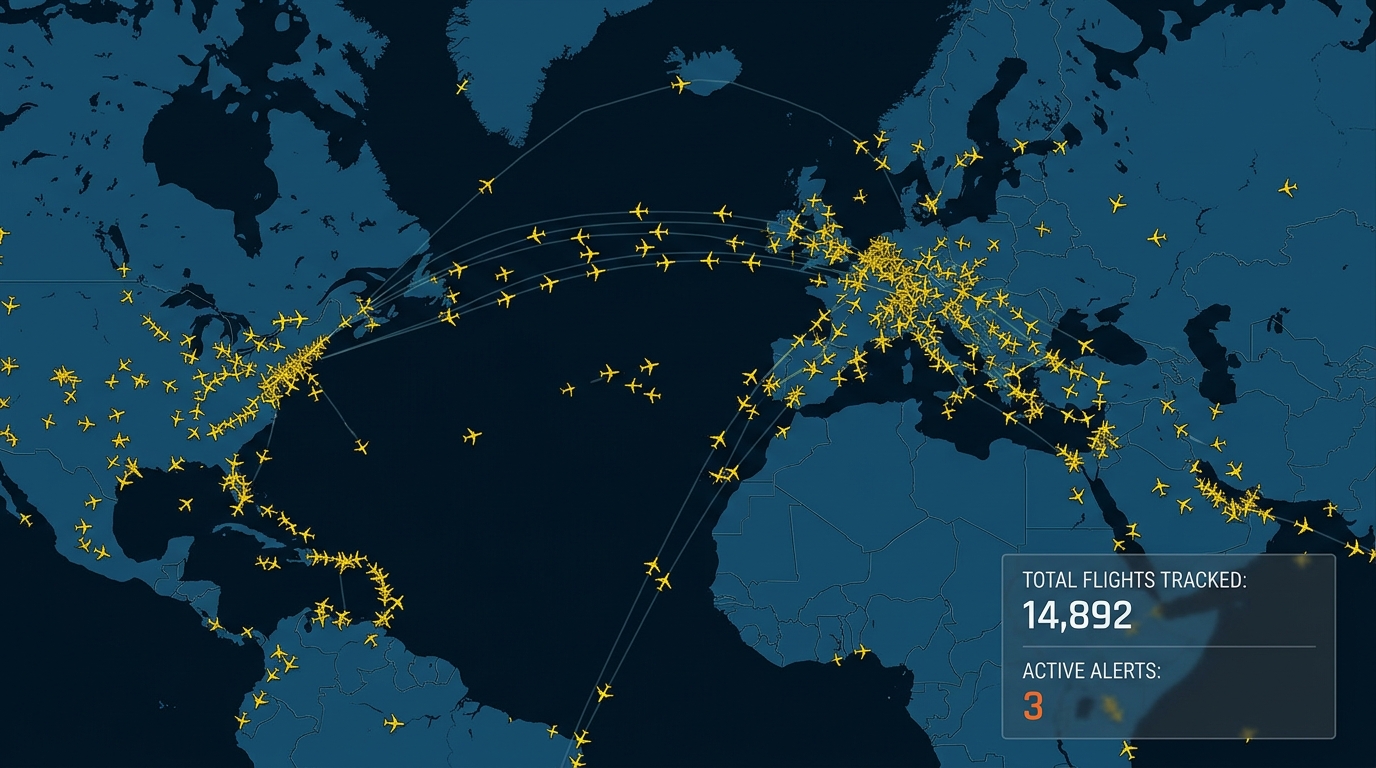
    Beyond tracking a single flight, a live air traffic tracker view shows every aircraft currently airborne across a region — or the entire globe — at once. Zooming out on most tracking platforms reveals thousands of moving dots representing commercial flights, cargo planes, and sometimes private aircraft, all updating simultaneously.

    This global view is genuinely useful beyond curiosity. It can help you:

    • Spot patterns during major weather events, like widespread rerouting around a storm system
    • Understand air traffic congestion around a specific region or time of day
    • Get a sense of how busy a route is before booking, which can hint at flight frequency and connection options

    How Accurate Is Live Flight Tracking, Really?

    It’s worth setting realistic expectations. A live flight status tracker is highly accurate for aircraft actively broadcasting ADS-B data over well-covered regions — position updates every few seconds are common. But accuracy can dip in a few situations:

    • Ground movement: some trackers show limited or delayed detail while an aircraft is taxiing before takeoff or after landing, since ADS-B ground coverage varies by airport.
    • Military or restricted aircraft: certain flights are intentionally excluded or anonymized on public tracking platforms for security reasons.
    • Data provider delays: free tiers of some tracking tools apply a short delay (commonly a minute or so) compared to their real-time paid feeds.
    • Scheduling vs. tracking data mismatch: a flight status showing “on time” based on airline schedule feeds can occasionally lag slightly behind what the live map position actually suggests, especially right around departure or arrival.

    None of this makes flight tracking unreliable — it just means treating the estimated times as, well, estimates, particularly in the final approach and landing window.

    Tips for Choosing the Right Flight Tracking Tool

    With so many options claiming to be the best way to track flights in real time, a few practical criteria make the decision easier:

    1. Check update frequency. Look for platforms that clearly state how often position data refreshes — true real-time tools update every few seconds, not every few minutes.
    2. Confirm map detail matches your needs. Casual users are usually fine with a simple map; frequent travelers may want terminal maps, gate info, and historical on-time performance data.
    3. Look for airport-level views, not just single-flight search, if you regularly need arrivals and departures information rather than tracking one specific plane.
    4. Test notification reliability before depending on an app for something time-sensitive like an airport pickup — a delayed push notification defeats the purpose of real-time tracking.
    5. Consider whether you need international coverage specifically, since not every free tool handles long-haul, cross-ocean routes with the same consistency as domestic flights.

    Live Flight Tracking vs. Flight Status Checking: What’s the Difference?

    These two terms get used interchangeably, but they’re not quite the same thing, and knowing the difference helps set the right expectations.

    Flight status checking relies on schedule and airline-reported data — it tells you whether a flight is “on time,” “delayed,” or “cancelled,” based on information the airline pushes out. It’s accurate for high-level status, but it won’t show you exactly where the aircraft physically is at a given moment.

    Live flight tracking goes a layer deeper by combining that same status data with the aircraft’s actual broadcast position. Instead of just “delayed,” you can see why it looks delayed — maybe it’s still on the ground, maybe it’s airborne but flying a longer route around weather, or maybe it’s already in its descent and simply running a few minutes behind the printed time.

    For most everyday situations, a good real time flight tracker gives you both pieces of information in one place, which is why dedicated tracking platforms have largely replaced the old habit of just checking an airline’s status page.

    Getting the Most Out of a Flight Tracking App

    A few small habits make live flight tracking noticeably more useful day to day:

    • Save recurring flights, like a partner’s regular commute or a family member’s frequent visiting route, so you’re not re-searching the same flight number every time.
    • Cross-check time zones whenever a flight crosses regions, since a landing time shown in local destination time can look confusing if your app defaults to your home time zone.
    • Use airport-level views during high-traffic periods like holidays, when checking the whole airport’s arrivals board can be faster than tracking one flight in isolation if plans are still in flux.
    • Don’t rely solely on push notifications for anything truly time-critical — a quick manual check a few minutes before you need to leave for the airport is a good habit, since notifications can occasionally lag behind the live map.

    Final Thoughts

    A live flight tracker turns a genuinely useful piece of aviation technology — ADS-B broadcasting — into something anyone can use from their phone or browser. Whether you’re timing an airport pickup, tracking a loved one’s connecting flight, or just watching global air traffic move in real time out of curiosity, knowing how to track a flight in real time takes just a flight number and a few taps. Pick a tool that matches how often you actually need to track flights — a simple free tracker for occasional use, or a dedicated real-time flight tracking app if travel is a regular part of your life — and you’ll never be left guessing whether a flight is actually on time again.

    Frequently Asked Questions

    Can I track any flight, or only certain airlines?

     Most commercial flights from major airlines are trackable, since virtually all modern commercial aircraft broadcast ADS-B data. Smaller private aircraft, older planes without ADS-B equipment, and certain government or military flights may not appear on public trackers.

    Do I need to download an app to track a flight?

     No — a browser-based live flight tracker online works fine for a one-off search. An app is more useful if you want notifications or plan to track flights regularly.

    Why does a flight I’m tracking sometimes disappear from the map?

     This usually happens during takeoff, landing, or over regions with limited ADS-B ground coverage, such as remote areas or open ocean. The aircraft reappears once it’s back within receiver range or transitions to satellite-based coverage.

    Is live flight tracking free?

     Most flight tracking platforms offer a solid free tier covering flight number search, basic map view, and delay status. Paid tiers typically add features like true real-time updates without delay, historical data, and more detailed aircraft information.

    How early can I start tracking a flight before it departs? 

    Scheduling information is usually available as soon as the flight is published by the airline, often months in advance. Live position tracking only becomes available once the aircraft is actually airborne (or sometimes while taxiing, depending on airport ADS-B coverage).

    Can I track a flight worldwide, no matter where it’s flying? 

    A capable live flight tracker worldwide tool should cover the vast majority of commercial routes globally, though coverage density varies by region. Busy international corridors are generally tracked reliably; remote airspace may show sparser updates.

  • A Boston-to-London Flight That Went Nowhere Fast: Inside American Airlines’ Rough Week on Route AA108

    A Boston-to-London Flight That Went Nowhere Fast: Inside American Airlines’ Rough Week on Route AA108

    Not every flight story is about record-breaking speed or distance sometimes the most interesting thing to watch unfold is exactly how much can go wrong on what should be a routine transatlantic hop. That’s exactly what happened this week to American Airlines flight AA108, the daily Boston-to-London service, and anyone following along with a live flight tracker online got a front-row seat to one of the more frustrating travel sagas in recent memory.

    Cancellation Number One

    The trouble started before anyone even left the ground. The scheduled AA108 departure was called off due to a mechanical issue discovered before takeoff. The Boeing 777-200ER assigned to the route was pulled from service, and the airline worked to get a replacement aircraft back into rotation the next day.

    Diversion Number One: Boston to… New York

    The following evening, AA108 finally got airborne only for the flight crew to notice a problem with the landing gear failing to retract properly shortly after departure. Rather than risk continuing across the Atlantic, the crew made the call to divert to New York’s JFK Airport instead, where a different aircraft and crew were standing by to pick up the journey to London. Anyone who had that flight open on a track flight live view would have watched the aircraft turn south toward New York instead of continuing out over the ocean.

    Diversion Number Two: New York back to Boston

    A few hours later, passengers boarded the replacement aircraft in New York and set off for London a second time. About 45 minutes into the flight, the crew reported an issue with one of the engines and this time the aircraft diverted back to Boston, burning off fuel over the coast before landing safely. For passengers, it meant they’d now flown Boston to New York to (almost) London and finally back to Boston, without ever leaving North America.

    Why Stories Like This Are Made for Real-Time Tracking

    Disruption stories like AA108’s are exactly why so many travelers and aviation enthusiasts keep a live airplane tracker open during long-haul journeys. A flight tracking live map turns a confusing string of delays and gate changes into something you can actually see the aircraft climbing out, turning back, and landing somewhere completely different from where it was headed.

    Anyone with a live air traffic tracker running that night would have watched the whole saga develop essentially live: takeoff, an unexpected turn toward New York, a multi-hour ground delay, a second takeoff, and then a second unexpected turn straight back to Boston. It’s the kind of real story that makes a good flight radar live view genuinely useful, not just for planespotters but for anyone with a friend or family member actually on board.

    Keeping Tabs on a Flight When Things Go Wrong

    If you’ve ever had a loved one on a flight that suddenly seems to be going the wrong way, you already know why a reliable plane tracker live matters. Here’s what makes the difference when a flight like AA108 hits trouble:

    • Track flights in real time so you can see a diversion happening as it happens, not an hour later from a confusing airline text message
    • A clear live flight status tracker that updates the destination the moment a diversion is confirmed
    • The ability to track international flights live, since even a “domestic-feeling” diversion like Boston-to-New York-to-Boston is technically part of an international routing
    • A dependable real time airplane tracking system that keeps showing accurate position data even during an unusual flight path

    Choosing the Best Flight Tracker App for Nights Like This

    Nights like AA108’s are the real test of whether a tracking tool is actually good, or just good enough for a normal, uneventful flight. Here’s what to look for in the best flight tracker app:

    • A genuinely real time flight tracking app that doesn’t freeze or lag right when things get interesting
    • Easy live flight tracker app download so you’re not scrambling to find a working link while worried about a delayed flight
    • A solid airplane tracker app experience with clear altitude, speed, and heading data, especially useful for spotting an unusual turn before it’s officially announced
    • A live flight tracker with map layout that makes it obvious at a glance when a flight is no longer heading toward its original destination
    • For casual tracking, a decent flight tracking app free option is often all you need to follow a single flight from takeoff to (eventual) landing

    And if you’ve never had to do it before, it’s worth knowing how to track a flight in real time before you actually need to because as AA108’s passengers found out, a routine flight can turn into a very long night with very little warning.

    The Takeaway

    American Airlines’ 777-200ER fleet has an average age of around 25 years, and mechanical hiccups do happen but rarely do they stack up into a cancellation and two diversions on the same route within 48 hours. For passengers, it was a long, frustrating trip to nowhere. For everyone else following along, it was a reminder of just how useful it is to have a trustworthy tracker open when a flight starts behaving unpredictably.

    Next time a flight you’re watching takes an unexpected turn, open LiveFlightTracker and follow it, live, all the way to wherever it actually ends up landing.

  • Airbus A350-1000ULR Sets a New World Distance Record: How to Follow Record-Breaking Flights Live

    Airbus A350-1000ULR Sets a New World Distance Record: How to Follow Record-Breaking Flights Live

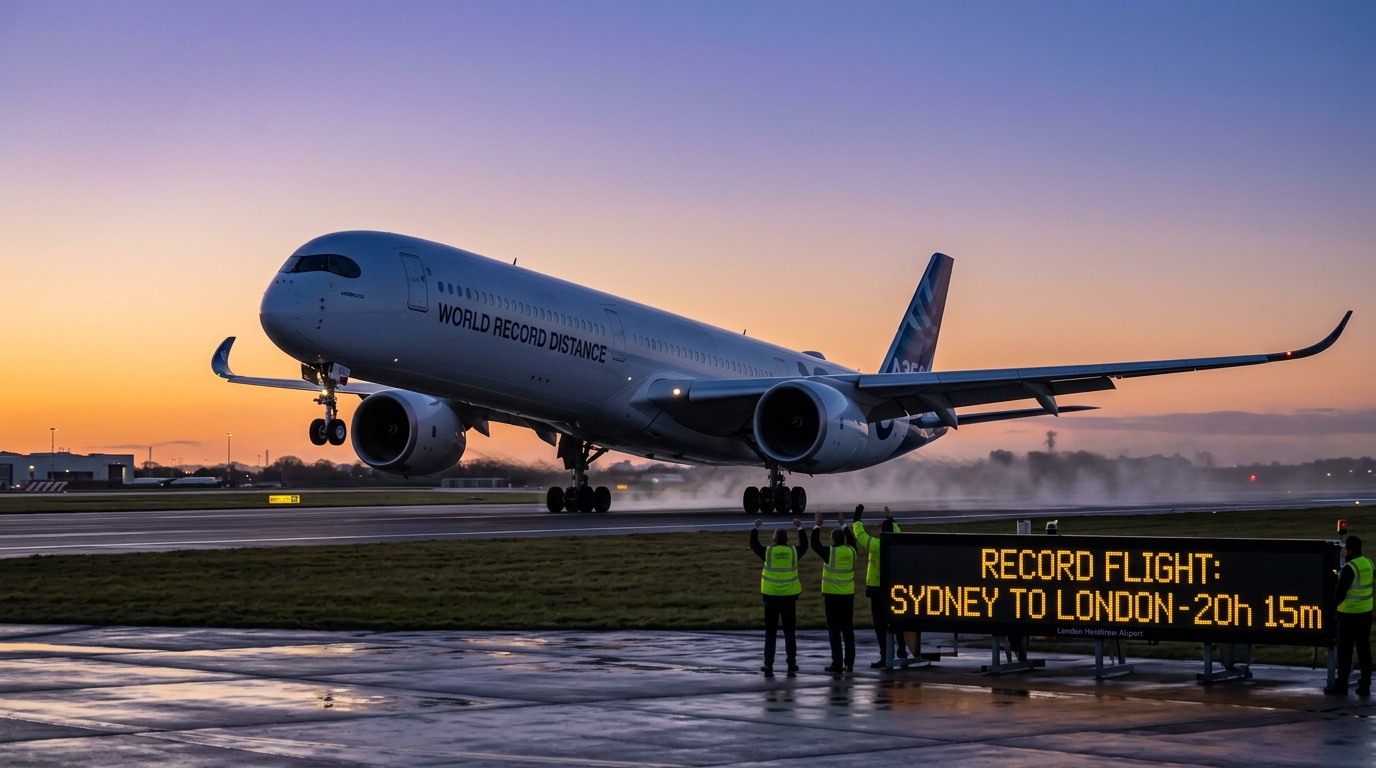
    Aviation history was made this week when Airbus’s ultra-long-range test aircraft, the A350-1000ULR, completed a non-stop flight from Melbourne to Toulouse that broke the world record for the longest distance ever flown by a commercial airliner. If you love watching moments like this unfold in real time, this is exactly the kind of event that shows why a live flight tracker online has become essential for aviation fans everywhere and at LiveFlightTracker, we watched every mile of it.

    A Record-Breaking Journey Across Three Continents

    The A350-1000ULR departed Melbourne and touched down at Airbus’s home base in Toulouse roughly 24 hours and 24 minutes later, covering an astonishing 12,460 nautical miles about 23,076 kilometers. That distance edges out the previous record, set back in 2005 by a Boeing 777-200LR, making this flight one of the most significant milestones in long-haul aviation in the last two decades.

    This particular aircraft variant is being developed for ultra-long-haul routes like Qantas’s Project Sunrise, which aims to connect Australia directly with cities in Europe and North America without a single stopover. To prove the aircraft is ready for that kind of mission, Airbus needed to demonstrate it could handle an extreme endurance test and it did, crossing three continents, two oceans, 17 time zones, and 19 different Flight Information Regions along the way, all while cruising at altitudes up to 41,000 feet and reaching ground speeds of 662 knots.

    For anyone who wants to relive the route or study exactly how a flight like this is planned and flown, a flight tracking live map makes it possible to see the entire path, from takeoff in the Southern Hemisphere to landing in southern France, in a single continuous view.

    Why Aviation Fans Couldn’t Stop Watching

    Flights like this attract enormous attention from the aviation community, and it’s easy to see why. Watching a live airplane tracker during a record attempt turns an abstract number “23,000 kilometers” into something you can actually witness: the aircraft crossing coastlines, flying through the night over open ocean, and finally arriving after a full day airborne.

    This is the same appeal that keeps millions of people coming back to check a live air traffic tracker every day, whether they’re tracking a special event like this one or simply keeping an eye on a loved one’s flight home. A good flight radar live view doesn’t just show a dot moving across a map it shows altitude, speed, heading, and aircraft type, which is exactly the kind of detail that turns a routine flight into a story worth following.

    How to Track Flights Like This Yourself

    If this story has you wanting to follow the next big aviation milestone as it happens, here’s what to look for in a plane tracker live service:

    • Track flight live coverage that updates in near real time, not just every few minutes
    • A live flight status tracker that shows departure and arrival times, delays, and gate information
    • The ability to track flights in real time anywhere in the world, not just over major cities or airports
    • A clean, readable live flight tracker with map view so you can actually follow the route visually

    Whether you’re watching a record-setting test flight or just curious how to track a flight in real time for a friend or family member landing tonight, the tools available today make it easier than ever to follow along from your phone, tablet, or computer.

    Choosing the Best Flight Tracker App for You

    Not all tracking tools are built the same way, so it’s worth knowing what separates a good one from a great one. Here’s what we recommend looking for in the best flight tracker app:

    • Real time flight tracking app performance that doesn’t lag behind the actual flight
    • Support to track international flights live, since long-haul and ultra-long-range flights like the A350-1000ULR often cross dozens of countries and air traffic regions
    • A dependable real time airplane tracking system that pulls from multiple data sources so coverage doesn’t drop out over remote areas or oceans
    • Easy live flight tracker app download options so you’re not stuck relying on a browser tab when you’re on the move
    • A genuinely useful airplane tracker app experience on both iOS and Android

    For those who prefer not to install anything at all, a solid flight tracking app free option in your browser can cover most everyday needs from checking your own upcoming trip to following a record-breaking flight like the one Airbus just completed.

    Conclusion

    Record flights like the A350-1000ULR’s Melbourne-to-Toulouse run are a reminder of just how far modern aircraft can go literally. They’re also a great example of why so many people have made real-time tracking part of their daily routine, whether they’re planning a trip, waiting on a delayed connection, or just fascinated by watching an aircraft cross the globe in a single flight.

    Next time something this big is happening in the sky, open up LiveFlightTracker and watch it unfold, mile by mile, in real time.

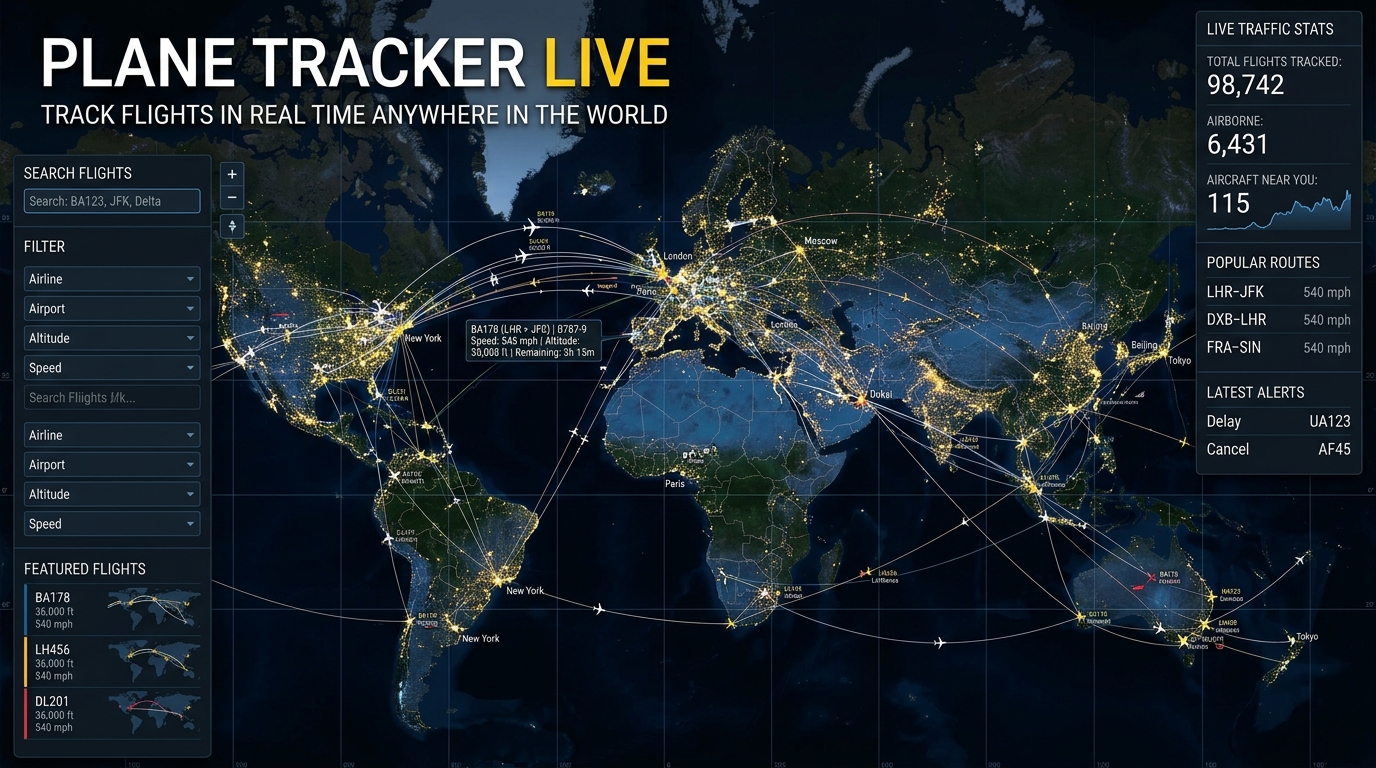
  • Plane Tracker Live: Track Flights in Real Time Anywhere in the World

    Plane Tracker Live: Track Flights in Real Time Anywhere in the World

    Someone lands on a live flight tracker online for one of a handful of reasons: they’re picking someone up and want to know the real arrival time, they’re anxious about a loved one’s flight through bad weather, they’re a planespotter who just enjoys watching aircraft move across a map, or they’re trying to track flight by number live because a connection is tight. Whatever the reason, the tools available in 2026 make it possible to track flights in real time almost anywhere on Earth and this guide is built as a practical walkthrough for actually doing it, not just an explanation of the technology behind it.

    Below is a hands-on look at how to choose a plane tracker live tool, what separates a genuinely good one from a mediocre one, and how to actually track flight live step by step whether it’s a domestic hop or an international route halfway around the world.

    Start Here: What Do You Actually Need to Track?

    Before comparing tools, it helps to be clear on the use case, because different plane tracker live platforms are optimized for different things.

    Tracking one specific flight (picking someone up, following a loved one) → You want a fast, simple live flight tracker online with a clean search-by-flight-number function.

    Tracking multiple flights regularly (frequent flyer, travel coordinator) → You want a real time flight tracking app with saved flights, notifications, and a watchlist.

    Watching global air traffic for fun or research → You want a full live air traffic tracker with a detailed, zoomable flight tracking live map covering wide regions at once.

    Managing cargo or logistics → You want a real time airplane tracking system with arrivals and departures data, ideally with export or API access for integrating into existing workflows.

    Once you know which of these describes you, picking the right tool becomes much easier.

    How to Track a Flight in Real Time: The Actual Steps

    Regardless of which platform you choose, the core process for how to track a flight in real time stays consistent:

    Step 1: Choose your platform. Decide between a live flight tracker online (browser-based) or a live flight tracker app download for your phone. Many people end up using both.

    Step 2: Search by flight number. This is the fastest way to track flight by number live type in the airline code and flight number (like AA100 or BA249) rather than searching by route, which returns a longer list of possible matches.

    Step 3: Confirm the correct flight. Since flight numbers can occasionally be reused for different routes on different days, double-check the departure and arrival airports match what you’re expecting before assuming you’ve found the right aircraft.

    Step 4: Watch the live position update. Once confirmed, the aircraft appears on a flight tracking live map, updating every few seconds as it moves. Tap or click the icon for altitude, speed, and estimated arrival details.

    Step 5: Set an alert (optional but useful). Most platforms let you follow a flight and receive push notifications for gate changes, delays, or landing confirmation genuinely useful if you’re not planning to stare at the map the whole time.

    Step 6: Check arrivals and departures if timing matters. A flight tracker arrivals and departures view shows scheduled vs. estimated times side by side, which is more useful than the live map alone when you’re trying to plan around an actual landing time.

    Best Flight Tracker App Options: What to Actually Compare

    When people ask what the best flight tracker app is, there’s rarely a single universal answer it depends on what matters most to the individual user. Here’s what to actually evaluate.

    Update Frequency

    The strongest real time flight tracking apps refresh positions every few seconds rather than every minute. If you’re watching a flight during takeoff, landing, or turbulence, this difference is very noticeable a slow-refreshing airplane tracker app can leave you looking at a plane’s position from two minutes ago during the exact moment you’re paying closest attention.

    Global Coverage

    Coverage isn’t uniform across the globe. Apps that blend satellite-based ADS-B data with traditional ground receivers tend to offer much more complete tracking when you’re trying to track international flights live, especially over oceans and remote regions where ground coverage alone leaves gaps.

    Free vs. Paid Features

    A flight tracking app free version typically covers the basics live position, scheduled times, basic status which is genuinely enough for most casual users. Paid tiers usually add things like ad-free browsing, historical flight playback, multiple saved flights, and more detailed weather overlays. Frequent flyers and anyone tracking flights professionally will usually find the paid tier worth it; casual users checking one flight a month generally won’t need it.

    Notification Reliability

    A live flight status tracker is only as useful as its alerts. Look for apps with a track record of sending timely gate change and delay notifications rather than ones that only update after you manually refresh this single feature makes the biggest practical difference for anyone using the app for airport pickups or connections.

    Map Usability

    A cluttered live flight tracker with map data crammed with overlapping icons and unnecessary detail can actually make it harder to find what you need. The best interfaces let you zoom cleanly, search quickly, and toggle extra layers (weather, airspace boundaries) on and off rather than forcing everyone to look at everything at once.

    Free Live Flight Tracking Website Options: What You Get Without Paying

    For most casual tracking needs, a free live flight tracking website covers everything necessary:

    • Live position of any commercial flight, updated in near real-time
    • Basic flight details: altitude, speed, origin, destination
    • Scheduled vs. estimated arrival times
    • A searchable, zoomable global map

    What free tiers typically don’t include: unlimited saved flights, ad-free browsing, historical route playback, or detailed premium weather overlays. For someone tracking a single flight for an airport pickup, none of that matters much the free tier does the job completely.

    Live Flight Tracker Worldwide: Handling International and Long-Haul Routes

    Tracking a flight within a single country is generally straightforward, since ground-based ADS-B coverage tends to be dense over populated regions. The bigger test for any live flight tracker worldwide is long-haul, transoceanic routes and this is where satellite-based tracking has made the biggest difference over the past couple of years.

    Older tracking systems relying solely on ground receivers would often lose a flight’s live position for hours once it crossed into open ocean airspace, only regaining it as the aircraft approached land again. Modern platforms using satellite ADS-B data close that gap almost entirely, meaning you can now track international flights live from taxi-out at the departure airport all the way through to landing, without the multi-hour blackout that used to be standard on long-haul routes.

    This matters practically for anyone tracking a transatlantic, transpacific, or polar route flight the live map should now show a continuous, unbroken flight path rather than a dotted-line estimate over the ocean.

    Track Flights in Real Time: Common Use Cases Worth Knowing

    Airport pickups. Instead of leaving based on a scheduled time that may no longer be accurate, checking a plane tracker live tool shortly before departure lets you time your drive around the actual estimated arrival.

    Connection anxiety. If you’re on one leg of a multi-flight trip and worried about a tight connection, tracking your own flight live gives a much more accurate sense of whether you’ll make it than relying on the airline’s app alone.

    Weather-related concern. During storms or turbulence-prone conditions, being able to track flight live watching altitude and speed stay consistent offers real reassurance in a way a static “in the air” status message simply doesn’t.

    Cargo and logistics coordination. Businesses managing shipments increasingly rely on a real time airplane tracking system to align warehouse and delivery schedules with actual arrival times rather than fixed, often outdated schedules.

    Aviation hobbyists. A large community uses a live air traffic tracker purely for enjoyment spotting specific aircraft types, following notable planes, or just watching global traffic patterns unfold.

    Plane Tracker Live: A Quick Feature Checklist

    When evaluating any airplane tracker app or website, run through this checklist:

    • ✅ Updates every few seconds, not every minute
    • ✅ Covers oceanic and remote routes via satellite data, not just ground receivers
    • ✅ Lets you search directly by flight number for fast, accurate results
    • ✅ Shows both live position and scheduled vs. estimated arrivals and departures
    • ✅ Sends real notifications for delays and gate changes, not just passive map updates
    • ✅ Offers a genuinely usable free tier, with clear (not misleading) paid upgrade options
    • ✅ Loads quickly and doesn’t bury the map behind excessive ads or pop-ups

    A tool checking most or all of these boxes will comfortably handle nearly any real-world tracking need, from a single domestic flight to monitoring international long-haul routes worldwide.

    Final Thoughts

    Whether the goal is a quick check before an airport pickup, ongoing monitoring of a loved one’s international trip, or simply the enjoyment of watching global air traffic move in real time, the tools available in 2026 make it easier than ever to track flights in real time from almost anywhere. The key is matching the tool to the actual need a simple live flight tracker online for a one-off check, a dedicated real time flight tracking app for frequent use, or a full live air traffic tracker for anyone who wants the entire sky visible at once.

    With satellite coverage closing the old oceanic tracking gaps and update speeds faster than ever, a plane tracker live tool today can follow a flight from taxi to touchdown, anywhere in the world, with a level of accuracy that simply wasn’t available even a few years ago.

    Frequently Asked Questions

    Can I track a flight without knowing the flight number? 

    Yes most platforms also allow searching by route (departure and arrival airport) or by airline and approximate departure time, though searching by flight number remains the fastest and most accurate method.

    Why does a flight sometimes disappear from the live map? 

    This usually happens in regions with limited ADS-B ground coverage and no satellite backup, though this has become rare on major routes as satellite tracking coverage has expanded. Occasionally it also reflects a brief data delay rather than an actual loss of signal.

    Is live flight tracking accurate enough to time an airport pickup? 

    Generally yes estimated arrival times based on live position data tend to be more accurate than a flight’s originally scheduled time, especially once the aircraft is within its final descent phase.

    Do I need a paid app to track international flights?

    Not necessarily. Many free live flight tracking website and app options now include satellite-based oceanic coverage as a standard feature rather than a premium add-on, though paid tiers may offer additional detail layered on top.

    What’s the difference between a flight tracker and an air traffic control map? 

    A flight tracker typically focuses on individual flights you search for directly, while an air traffic control map shows a broader regional or global view of all tracked aircraft at once useful for a wider picture rather than following one specific trip.

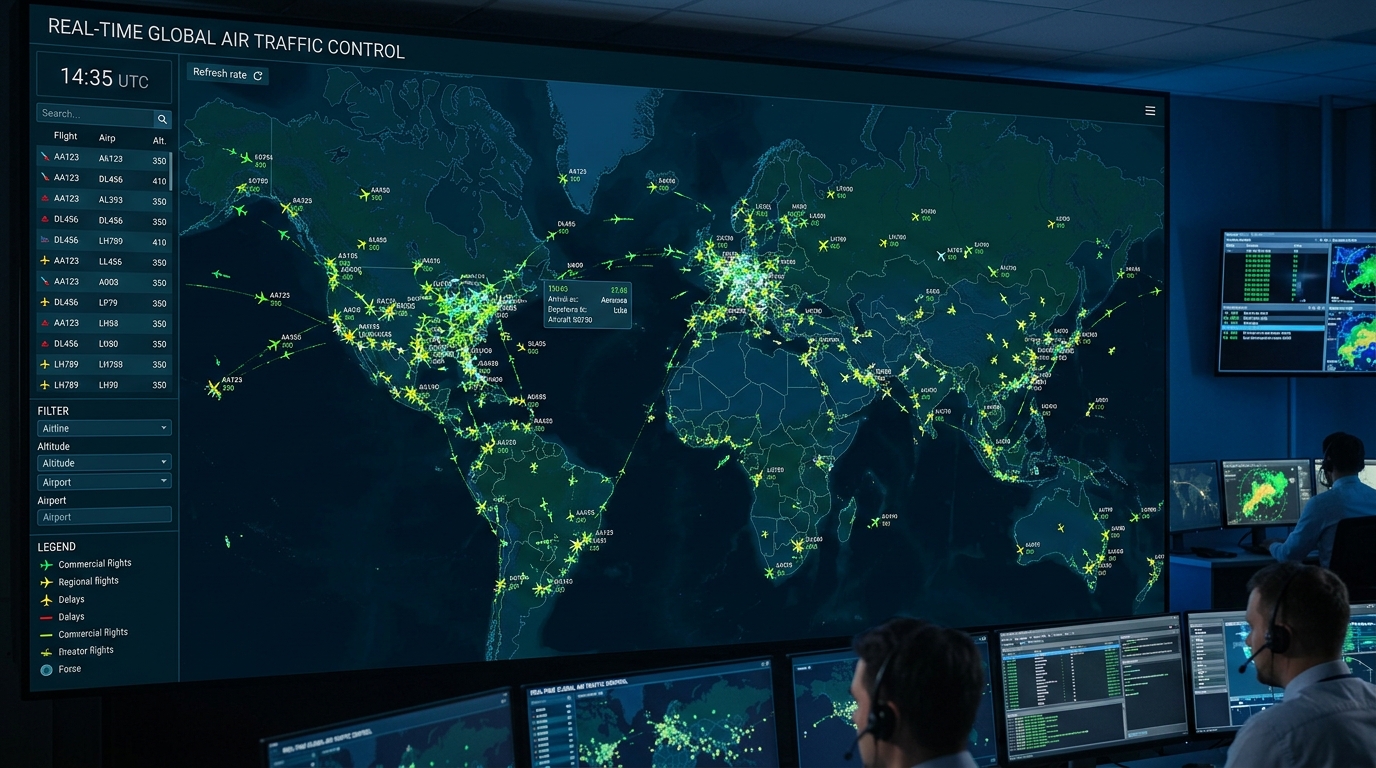
  • Real Time Air Traffic Control Map: Track Live Flights Worldwide

    Real Time Air Traffic Control Map: Track Live Flights Worldwide

    At any given moment, roughly ten thousand commercial aircraft are in the air somewhere on Earth. Open a real time air traffic control map today and you can watch nearly all of them at once tiny plane icons crawling across oceans, converging over major hub airports, banking into holding patterns before landing. It’s one of the most satisfying pieces of public data visualization the internet has ever produced, and in 2026 it’s more accurate, more global, and more accessible than at any point before.

    This guide walks through how a real time air traffic control map actually works, what’s changed in flight tracking technology heading into the second half of 2026, and how to use these tools whether you’re tracking a single loved one’s flight or just watching global air traffic unfold for fun.

    What a Real-Time Air Traffic Control Map Actually Shows

    A live air traffic control map is a visual layer sitting on top of a much larger data infrastructure. Every icon on the map represents a real aircraft, and clicking on it typically reveals its callsign, altitude, ground speed, heading, aircraft type, and route often down to the exact gate it departed from and the one it’s headed toward.

    What makes this different from a simple flight status page is scale. Instead of looking up one flight, an air traffic control map lets you see an entire region or the whole planet at once, which is why it’s become the go-to tool for aviation enthusiasts, journalists, logistics teams, and increasingly, everyday travelers who just want a broader picture of what’s happening in the sky.

    How Live Flight Tracking Data Actually Reaches Your Screen

    Behind every live airplane tracker is a layered system of data collection, and understanding it helps explain why some regions of the map are denser and more accurate than others.

    ADS-B Broadcasts

    Automatic Dependent Surveillance-Broadcast, or ADS-B, is the backbone of most modern flight tracking. Aircraft equipped with ADS-B transponders continuously transmit their GPS position, altitude, and speed roughly once per second. A global network of ground-based receivers some run by aviation authorities, many run by independent enthusiasts and tracking companies picks up these signals and feeds them into central servers.

    Satellite Coverage Over Oceans and Remote Regions

    Ground stations can’t cover open ocean or remote wilderness, which used to leave large gaps in coverage for transatlantic and transpacific flights. Satellite-based ADS-B receivers now fill much of that gap, picking up aircraft signals from orbit and relaying them back down, which is a major reason modern tools can track international flights live across an entire journey rather than losing the aircraft mid-ocean for hours.

    Radar and Air Traffic Control Feeds

    In regions with limited ADS-B ground infrastructure, or for older aircraft not broadcasting ADS-B, secondary radar data sourced from air traffic control systems fills in additional detail, helping keep the live map more complete.

    Airline Schedule Data

    Beyond raw position data, tracking platforms also pull scheduled departure and arrival times directly from airlines, which is what allows a flight tracker arrivals and departures view to show whether a flight is on time, delayed, or diverted not just where the aircraft currently sits on the map.

    All of these sources merge together on the backend, producing the smooth, continuously updating flight tracking live map that users see on-screen.

    Flight Radar Live: Reading the Map Like a Pro

    For newcomers, a flight radar live display can look overwhelming hundreds or thousands of moving icons packed over busy airspace. A few tips make it much easier to read:

    • Zoom into a region rather than trying to track the whole globe at once. Busy corridors like the Northeast US, Western Europe, or East Asia will always look dense; zooming in reveals individual flight paths more clearly.
    • Use the search function to jump directly to a specific flight number, airline, or airport instead of scanning visually.
    • Color coding matters. Most platforms color-code aircraft by altitude or status (in-flight, delayed, landed), which makes it much faster to spot what’s actually relevant to you.
    • Toggle layers like weather overlays or airspace boundaries, when available, to understand why a flight might be taking an unusual path often due to storms or restricted airspace.

    Best Flight Tracker Apps in 2026: What Actually Matters

    With no shortage of options, choosing the best flight tracker app comes down to a handful of practical factors rather than flashy marketing.

    Update Speed

    The strongest real time flight tracking app refreshes positions every few seconds. This matters most when watching a flight during takeoff, landing, or turbulent weather, when a slow refresh can leave you looking at outdated information during the moments you care about most.

    Coverage Depth

    Since ADS-B ground coverage varies heavily by region, apps combining satellite data with terrestrial receivers offer far more consistent results especially important for anyone trying to track flights in real time over oceans, deserts, or sparsely populated regions.

    Free vs. Paid Tiers

    Most flight tracking app free versions cover the essentials: live position, scheduled times, and basic status. Paid tiers typically add ad-free tracking, historical flight playback, more detailed weather layers, and the ability to follow multiple flights on a personalized watchlist useful for frequent flyers or anyone managing several shipments or travelers at once.

    Notifications

    A quality live flight status tracker should push proactive alerts gate changes, delays, cancellations rather than requiring constant manual refreshing. This single feature tends to matter most to people using the app for practical purposes like airport pickups, rather than casual browsing.

    Interface Clarity

    A map cluttered with too many overlapping icons and data points can actually make it harder to track flight live. The best-designed apps balance detail with a clean, intuitive interface that surfaces the information you actually need without extra taps.

    Live Flight Tracker Online vs. Downloading an App

    Both options exist for a reason, and the right one depends on how you plan to use it.

    A live flight tracker online, accessed through a browser, works well for a quick check glancing at a flight’s status from a laptop or shared computer without needing to install anything. It’s also often the fastest way to get a full-screen view of a live air traffic tracker map, since desktop browsers give more room to explore a busy region.

    A live flight tracker app download, on the other hand, is better suited for ongoing tracking following a specific trip over several hours, receiving push notifications, or checking status quickly from a phone while heading to the airport. Most serious frequent travelers end up using both: the app for day-to-day tracking, and the desktop site for a broader, more detailed map view.

    Either way, most reputable platforms sync data between their web and mobile experiences, so switching between a live flight tracker online and an airplane tracker app doesn’t mean losing any functionality.

    How to Track a Flight in Real Time: A Step-by-Step Walkthrough

    For anyone new to the process, tracking a specific flight is straightforward:

    1. Open a live flight tracker online or launch your flight tracker app.
    2. Search by flight number or airline and route. This is usually the fastest way to locate a specific aircraft on a busy live map.
    3. Watch the aircraft move in real time. Once found, the plane appears as an icon that updates its position every few seconds as it flies its route.
    4. Tap or click for full flight details. This typically reveals altitude, speed, estimated arrival, gate information, and current status.
    5. Set an alert if you want ongoing updates. Most platforms let you follow a flight and receive notifications for delays, gate changes, or confirmed landing.

    This same process works whether you’re checking a short regional hop or trying to track international flights live from departure to arrival across multiple continents and time zones.

    Watching Global Air Traffic: More Than Just One Flight

    Beyond tracking an individual trip, a live air traffic tracker becomes genuinely fascinating when you zoom out and watch entire regions of airspace at once. This broader view has real, practical uses beyond curiosity:

    Aviation enthusiasts, sometimes called planespotters, use full air traffic control maps to identify aircraft types, follow specific historic or notable planes, and simply enjoy watching global air traffic patterns unfold in real time.

    Logistics and cargo teams monitor multiple shipments across different flights simultaneously, using a real time airplane tracking system to coordinate ground transportation and warehouse timing around actual arrival data rather than fixed schedules.

    Journalists and researchers have increasingly used live air traffic tracker data to observe flight patterns during major weather events, geopolitical developments, or natural disasters, since sudden shifts in air traffic can reflect real-world events unfolding in real time.

    Airport operations staff cross-reference live regional traffic with ground operations to anticipate congestion, gate conflicts, and taxiway delays before they become visible problems.

    Real Time Airplane Tracking System: What’s Improved in 2026

    Flight tracking technology continues to evolve, and a few developments stand out this year.

    Expanded satellite coverage has closed most of the remaining gaps over oceans and remote regions, meaning full end-to-end tracking of long-haul international flights is now close to standard rather than a rare feature.

    AI-assisted delay prediction is increasingly layered on top of raw tracking data, helping some platforms forecast likely delays before they’re officially announced, based on historical patterns and current conditions.

    Deeper integration with airline and airport systems means gate changes and status updates increasingly come directly from operational sources rather than relying solely on publicly broadcast position data, improving overall accuracy.

    Richer overlays, including live weather and turbulence forecasting layered directly onto the map, give users a fuller picture of what’s actually happening around a tracked flight not just its current coordinates.

    Practical Everyday Uses for a Live Flight Tracker

    It’s easy to think of flight tracking as a niche hobby, but the practical, everyday use cases have grown substantially.

    Airport pickups. Instead of guessing based on a scheduled arrival time, checking a live flight status tracker lets you time your drive around the actual estimated landing, saving unnecessary waiting.

    Business travel coordination. Companies increasingly use a real time flight tracking app to monitor employee travel, proactively rebooking connections when delays are detected rather than reacting after the fact.

    Cargo and supply chain management. Freight operators rely on flight tracker arrivals and departures data to align warehouse staffing and delivery schedules with actual aircraft arrival times.

    Personal peace of mind. Whether it’s a family member flying during severe weather or simply a long-haul trip someone wants to follow along with, being able to track flight live offers a level of reassurance that a static arrivals board never could.

    Choosing the Right Tool for Your Needs

    Not everyone needs the same depth of tracking. A quick decision framework:

    • Just checking one upcoming flight? A simple live flight tracker online search by flight number is usually all you need.
    • Frequently traveling or picking people up regularly? A dedicated real time flight tracking app with notifications is worth installing.
    • Interested in aviation as a hobby, or monitoring multiple shipments? A full-featured live air traffic tracker with a detailed regional or global map view offers far more value than a basic single-flight lookup.
    • Managing business travel or logistics at scale? Look for platforms offering API access or multi-flight dashboards designed specifically for that kind of monitoring.

    Final Thoughts

    What used to require specialized aviation equipment is now available to anyone with an internet connection. A real time air traffic control map in 2026 blends ADS-B ground networks, satellite coverage, radar data, and airline scheduling information into a single, smooth, constantly updating view of the sky letting anyone track flight live, watch flight tracker arrivals and departures, or simply follow global air traffic for the sheer novelty of it.

    Whether you’re timing an airport pickup, coordinating business travel, monitoring cargo shipments, or just enjoy watching planes cross an interactive live map, today’s tracking tools make real-time visibility into global air traffic more detailed, more reliable, and more genuinely useful than it’s ever been.

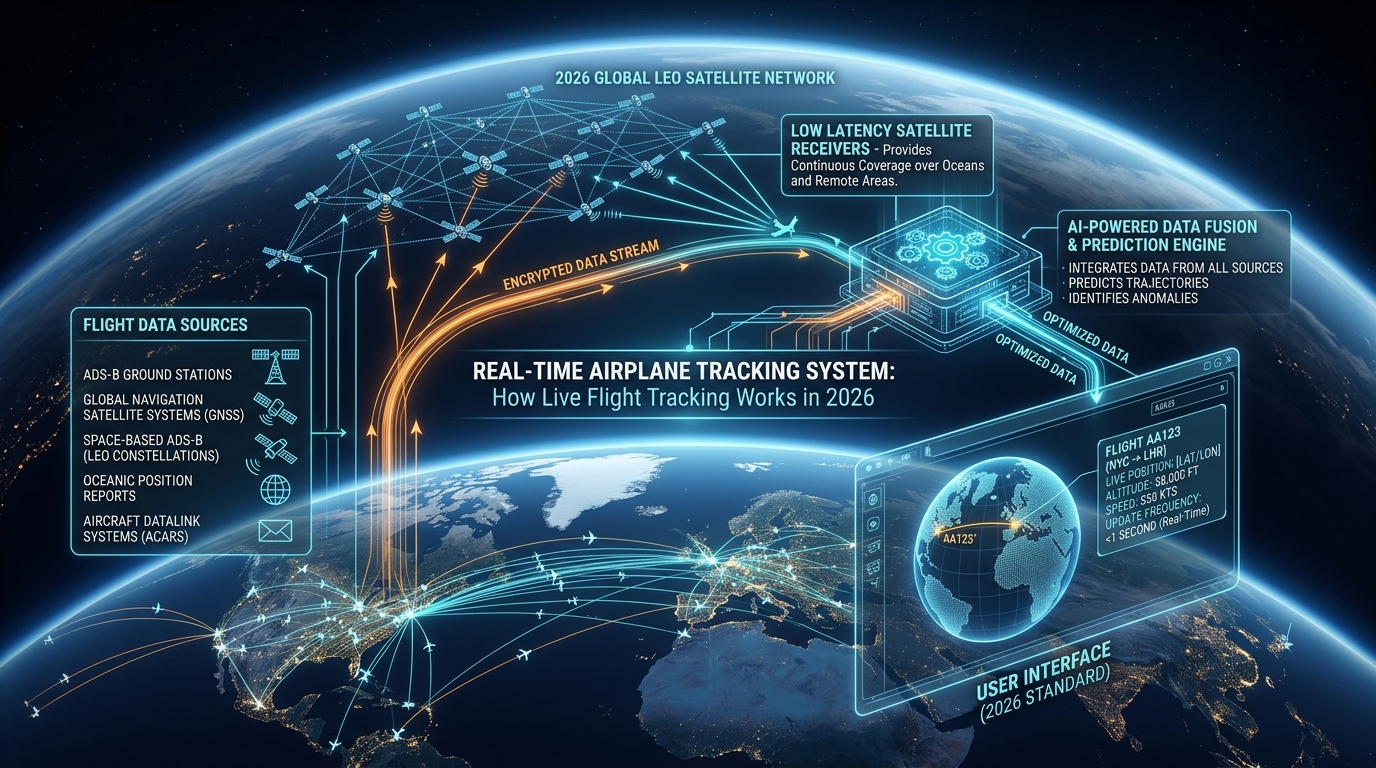
  • Real-Time Airplane Tracking System: How Live Flight Tracking Works in 2026

    Real-Time Airplane Tracking System: How Live Flight Tracking Works in 2026

    Open any live flight tracker online today and you’ll see thousands of aircraft moving across a world map in real time — climbing, cruising, banking into approach paths, landing at airports thousands of miles apart. It feels almost magical, but behind that smooth, glowing map is a genuinely fascinating web of satellites, ground receivers, radar networks, and data pipelines working together to update your screen every few seconds.

    In 2026, real-time flight tracking has become more accurate, more accessible, and more widely used than ever — not just by aviation professionals, but by everyday travelers, families waiting at the gate, cargo logistics teams, and aviation enthusiasts who simply enjoy watching planes cross the globe. This guide breaks down exactly how a real time airplane tracking system works, what technology powers it, and how to actually use these tools to track flights live with confidence.

    Why Live Flight Tracking Has Become So Popular

    A decade ago, checking on a flight meant calling an airline or refreshing a departures board at the airport. Today, anyone can open an app and track flight live, down to the exact altitude, speed, and estimated arrival time of a specific aircraft, often from anywhere in the world.

    A few factors have driven this shift:

    1. Increased flight volume. With global air travel continuing to grow, more people have a personal reason to check on a flight — picking someone up, coordinating a connection, or simply managing travel anxiety.

    2. Better data accessibility. Aviation data that used to be restricted to air traffic controllers and airlines is now available through open ADS-B networks, making live tracking far more transparent.

    3. Smartphone-first travel habits. Nearly everyone now expects the same real-time visibility from a flight tracking app that they get from a rideshare app or delivery tracker.

    4. Logistics and cargo demand. Businesses tracking freight, charter flights, or corporate travel rely on real time flight tracking apps to manage schedules and respond quickly to delays.

    How a Real-Time Airplane Tracking System Actually Works

    At its core, a real time airplane tracking system pulls together several independent data sources and merges them into a single, continuously updating live map. Here’s how the process breaks down.

    1. ADS-B: The Backbone of Modern Flight Tracking

    Automatic Dependent Surveillance-Broadcast, or ADS-B, is the technology responsible for most of what you see on a live flight tracker with map today. Aircraft equipped with ADS-B transponders continuously broadcast their GPS-derived position, altitude, speed, and heading roughly once per second.

    Ground-based receivers — often operated by aviation enthusiasts, tracking companies, and official aviation authorities — pick up these signals and relay them to central servers. That data is then processed and displayed on the live maps used by flight tracking platforms.

    2. Satellite-Based Tracking for Oceanic and Remote Routes

    Ground receivers work well over populated land areas, but they can’t cover the middle of an ocean or remote airspace. This is where satellite-based ADS-B comes in. Networks of low-earth-orbit satellites now pick up ADS-B signals from aircraft flying over oceans, polar routes, and other remote regions, closing the coverage gaps that used to leave transoceanic flights essentially invisible on tracking maps for hours at a time.

    This satellite layer is one of the biggest upgrades to real-time airplane tracking systems in recent years, and it’s a major reason why users can now track international flights live across an entire journey — not just the portions near major airports.

    3. Radar Data From Air Traffic Control Networks

    In regions where ADS-B coverage is still limited, or for aircraft not broadcasting ADS-B data, tracking platforms often supplement with secondary surveillance radar data sourced from air traffic control systems. This adds another layer of accuracy, particularly for older aircraft or specific airspace regions with less ADS-B ground infrastructure.

    4. Flight Plan and Schedule Data

    Beyond live position data, a flight tracking arrivals and departures system also pulls in scheduled flight data directly from airlines and airports — flight numbers, scheduled departure and arrival times, gate assignments, and aircraft type. This is what allows a flight tracker to show not just where a plane is right now, but whether it’s on time, delayed, or diverted, and to let users track flight by number live rather than needing to know exact coordinates.

    5. Data Aggregation and the Live Map Display

    All of these sources — ADS-B ground stations, satellite feeds, radar data, and airline schedule data — get merged by the tracking platform’s backend systems. The result is what users see: a live airplane tracker map showing aircraft icons moving smoothly across the globe, each one clickable for details like altitude, ground speed, origin, destination, and flight status.

    What You Can See on a Modern Flight Tracker

    A quality real time flight tracking app in 2026 typically shows far more than just a moving dot on a map. Standard details usually include:

    • Current altitude and ground speed
    • Heading and flight path (past and projected)
    • Origin and destination airports
    • Scheduled vs. estimated arrival time
    • Aircraft type and, on many platforms, tail number
    • Departure and arrival gate information
    • Delay status and reason (when available)
    • Historical flight path playback

    Some more advanced platforms also layer in live weather overlays, turbulence forecasts, and airspace congestion data — giving users a much fuller picture of what’s actually happening around a specific flight, not just its dot on the map.

    Best Flight Tracker Apps in 2026: What to Look For

    With dozens of options available, choosing the best flight tracker app comes down to a few practical factors:

    Accuracy and Update Frequency

    The best real time flight tracker apps refresh aircraft positions every few seconds rather than every minute or longer. Faster refresh rates matter most for people actively watching a flight during takeoff, landing, or turbulence-heavy conditions.

    Global Coverage

    Since ADS-B ground coverage varies by region, apps that combine satellite tracking with terrestrial data tend to offer far more consistent global coverage — especially important for anyone trying to track international flights live over oceans or remote airspace.

    Free vs. Premium Features

    Most flight tracking app free tiers cover the basics — live position, scheduled times, and basic flight status. Premium tiers usually unlock features like ad-free tracking, more detailed weather overlays, historical flight data, and multi-flight watchlists, which are especially useful for frequent travelers or logistics professionals.

    Interface and Map Usability

    A cluttered map with too much overlapping data can actually make it harder to track flight live. The strongest apps balance detail with clarity — clean map design, intuitive search, and quick access to arrivals and departures boards without requiring multiple taps to find basic information.

    Notification and Alert Systems

    A strong live flight status tracker should proactively notify users of gate changes, delays, and cancellations rather than requiring users to manually refresh. This is one of the most valued features among frequent flyers and anyone coordinating airport pickups.

    How to Track a Flight in Real Time: Step-by-Step

    For anyone new to flight tracking, the process is simpler than it might seem:

    1. Choose a live flight tracker online or download a flight tracker app. Most major platforms offer both a website version and a mobile app.
    2. Search by flight number or route. Entering the airline code and flight number is usually the fastest way to track flight by number live, though you can also search by departure and arrival airport.
    3. View the live map. Once located, the aircraft will appear as an icon on a live airplane tracker map, updating in near real-time as it moves along its route.
    4. Check flight details. Tap or click the aircraft icon to view altitude, speed, estimated arrival time, and current status.
    5. Set alerts if needed. Many apps allow you to follow a specific flight and receive push notifications for delays, gate changes, or landing confirmation.

    This process works whether you’re tracking a short domestic hop or trying to track international flights live across multiple time zones.

    Live Air Traffic Tracker: Watching More Than One Flight at a Time

    Beyond tracking a single flight, many enthusiasts and professionals use a live air traffic tracker to view broader air traffic patterns — entire regions of airspace filled with dozens or hundreds of aircraft simultaneously. This view is particularly popular among:

    • Aviation enthusiasts (often called “planespotters”) who enjoy watching air traffic patterns, identifying aircraft types, or tracking specific historic or notable aircraft
    • Logistics and cargo teams monitoring multiple shipments across different flights at once
    • Airport operations staff cross-referencing live traffic with ground operations
    • Journalists and researchers tracking flight patterns during major news events, natural disasters, or geopolitical developments

    A full live air traffic tracker view essentially turns the entire sky into a real-time dashboard, and it’s one of the more visually striking uses of modern flight tracking data.

    Flight Radar Live: Understanding the Terminology

    You’ll often see terms like “flight radar,” “live flight tracker,” and “real-time airplane tracking system” used somewhat interchangeably, but there are subtle differences worth understanding:

    • Flight radar live generally refers to platforms that visualize ADS-B and radar data on a live map, similar to how weather radar visualizes storm systems.
    • Live flight tracker usually refers to the broader category of apps and websites offering real-time flight position and status data.
    • Real-time airplane tracking system describes the underlying infrastructure — the combination of ADS-B receivers, satellites, radar feeds, and data processing — that powers the tracker itself.

    Understanding this distinction helps when comparing platforms, since some prioritize a radar-style visual experience while others focus more on flight status, scheduling, and arrivals and departures data.

    Common Use Cases for Real-Time Flight Tracking in 2026

    Airport Pickups and Personal Travel

    One of the most common everyday uses of a live flight status tracker is simply knowing when to leave for the airport to pick someone up. Instead of guessing based on a scheduled time, users can track flight live and adjust their timing based on actual arrival estimates.

    Business Travel Coordination

    Companies managing employee travel increasingly rely on real time flight tracking apps to monitor delays and rebook connections proactively, reducing downtime and missed meetings.

    Cargo and Logistics Management

    Freight companies and supply chain teams use flight tracking arrivals and departures data to coordinate ground transportation, warehouse staffing, and delivery timelines around actual aircraft arrival times rather than fixed schedules.

    Aviation Enthusiasts and Planespotting

    A large and passionate community uses live airplane trackers purely out of interest — following specific aircraft, spotting rare plane types, or tracking historic flights and special routes.

    Safety Monitoring and Family Reassurance

    During weather events or when following a loved one’s journey, being able to track a flight in real time offers peace of mind that a scheduled arrival board simply can’t provide.

    The Future of Real-Time Airplane Tracking Systems

    Flight tracking technology continues to evolve, and a few trends are shaping where it’s headed:

    Improved satellite coverage is closing the remaining tracking gaps over oceans and remote regions, meaning full end-to-end tracking of international flights is becoming the standard rather than the exception.

    AI-powered delay prediction is increasingly being layered into tracking platforms, using historical data and current conditions to forecast delays before they’re officially announced.

    Integration with airport and airline systems is making live tracking data more consistent, pulling gate changes and status updates directly from operational systems rather than relying solely on public broadcast data.

    More detailed weather and turbulence overlays are giving travelers a fuller understanding of what’s happening around their flight, not just where it currently is.

    Final Thoughts

    What used to require specialized aviation equipment or insider access is now available to anyone with a smartphone. A real-time airplane tracking system in 2026 combines ADS-B ground networks, satellite coverage, radar data, and airline scheduling information into a single, easy-to-read live map — letting anyone track flight live, monitor arrivals and departures, or simply watch global air traffic unfold in real time.

    Whether you’re coordinating an airport pickup, managing business travel, tracking cargo shipments, or just enjoy watching planes move across a live map for fun, today’s best flight tracker apps make real-time flight tracking more accurate, more accessible, and more useful than it’s ever been.

  • Live Flight Status Tracker for Travelers: Never Miss a Flight Update Again

    Live Flight Status Tracker for Travelers: Never Miss a Flight Update Again

    you are sitting at the airport gate, your phone buzzing every few minutes with notifications, and you have absolutely no idea whether your flight is on time, delayed, or about to be cancelled entirely. Or maybe you are at home, anxiously waiting for a loved one’s plane to land, refreshing the airline’s website over and over, hoping for an update that never seems to come fast enough.

    This used to be the normal travel experience. Not anymore. In 2026, a good live flight status tracker has become an essential travel companion — turning that uncertainty into clarity with a single glance at your phone or laptop. Whether you want to track flight live for your own upcoming trip, monitor a connecting flight, or simply watch planes move across a live air traffic tracker out of curiosity, the technology behind modern flight tracking has become remarkably accurate, fast, and easy to use.

    Why Real-Time Flight Tracking Matters More Than Ever in 2026

    Air travel has become busier, more complex, and in many ways more unpredictable than it was just a few years ago. Weather disruptions, air traffic congestion, and operational delays have all increased the importance of having access to a reliable real time flight tracker rather than relying solely on airport announcements or airline apps that often update slower than the actual situation on the ground.

    A modern live flight status tracker pulls data directly from aviation surveillance networks, often updating positions and status information every few seconds. This means travelers, family members waiting at arrivals, and even logistics teams coordinating ground transportation can all access the exact same accurate, real-time picture of where a plane is and when it is expected to arrive.

    Beyond simple convenience, this technology has genuine practical value. Knowing in advance that your flight is delayed means you can adjust your schedule, rebook a connecting flight, or simply relax instead of rushing through security only to wait at a gate for an extra two hours. For frequent flyers and travel-dependent professionals, a dependable flight tracking live map is no longer a nice-to-have — it is a core part of modern travel planning.

    How a Live Flight Tracker Online Actually Works

    Understanding the technology behind flight tracking helps explain why some tools are more accurate and reliable than others. Most modern systems that let you track flights in real time rely on a combination of data sources working together.

    ADS-B Technology

    The majority of commercial aircraft today are equipped with Automatic Dependent Surveillance-Broadcast (ADS-B) transponders. These devices continuously broadcast the aircraft’s exact GPS position, altitude, speed, and heading. A network of ground-based receivers around the world picks up these signals and feeds the data into flight tracking platforms, which is how a live airplane tracker can show you an aircraft’s position updating in near real time, sometimes refreshing every one to two seconds.

    Radar Data Integration

    In regions where ADS-B ground coverage is limited — particularly over oceans and remote areas — flight tracking platforms supplement their data with traditional radar feeds from air traffic control systems. This is why a comprehensive live air traffic tracker can maintain visibility on flights even when they are flying over areas without dense ground receiver networks.

    Airline and Airport Data Feeds

    Beyond raw positional data, the best flight radar live platforms also integrate directly with airline scheduling systems and airport operational databases. This is what allows a tracker to show you not just where a plane is physically located, but also gate information, scheduled versus estimated arrival times, baggage claim details, and the reason behind any delays — information that pure positional radar data alone cannot provide.

    How to Track a Flight in Real Time: Step-by-Step

    If you have never used a flight tracking platform before, the process is simpler than most people expect. Here is exactly how to track a flight in real time, whether you are checking your own upcoming trip or monitoring someone else’s.

    Step 1: Gather Your Flight Information

    The most reliable way to find a specific plane tracker live result is by searching with the airline name and flight number — for example, “Delta 1234” or “BA287.” This information is usually printed on your boarding pass or confirmation email. If you do not have the flight number, most platforms also allow you to search by departure and arrival airport along with the approximate departure time.

    Step 2: Choose Your Tracking Platform

    Open your preferred live flight tracker online — whether that is a dedicated website or a flight tracking app free download on your phone. Enter the flight number into the search bar. Within seconds, most platforms will display the aircraft’s current status, whether it is scheduled, boarding, in the air, delayed, or landed.

    Step 3: View the Live Map

    Once you have located your flight, click through to the live flight tracker with map view. This visual representation shows the aircraft’s exact current position along its route, often including useful details like current altitude, ground speed, and estimated time remaining until arrival. Watching the plane icon move across the map in real time is one of the most reassuring parts of the entire experience for anxious travelers or family members waiting at the airport.

    Step 4: Set Up Notifications

    Most quality flight tracking apps allow you to save a flight and receive push notifications for status changes — gate assignments, delays, boarding announcements, and landing confirmations. This means you do not need to keep manually refreshing the app; the live flight status tracker will alert you the moment anything changes.

    Best Flight Tracker App Options in 2026

    With dozens of options available, choosing the best flight tracker app for your needs depends on what matters most to you — detailed data, a beautiful visual interface, offline access, or simply a fast, no-frills way to track flight live without creating an account.

    For Detailed Global Coverage

    Apps with extensive ground receiver networks provide the most comprehensive global coverage, including detailed aircraft type information, historical flight playback, and 3D visualization options. These platforms work well for aviation enthusiasts and frequent international travelers who want maximum detail from their real time flight tracking app.

    For Quick, No-Download Checks

    If you simply need to verify a flight status quickly without downloading anything, browser-based live flight tracker online tools are often the fastest option. Simply search the flight number directly, and you get an instant status update along with a live air traffic tracker map view — no account creation or app download required.

    For Frequent Travelers

    If you fly often, investing time in a live flight tracker app download that supports saved trips, multiple simultaneous flight tracking, and proactive delay alerts will save significant time and stress over the course of a year. Many of these apps also sync with your email to automatically detect upcoming flights from your confirmation emails.

    Quick Comparison: Popular Flight Tracking Options

    App / ToolBest ForFree Version?Map View
    Flightradar24Global coverage, detailed dataYes (limited)Yes — 3D & 2D
    FlightAwareUS flights, delay predictionsYes (limited)Yes
    Plane FinderHistorical playbackYes (limited)Yes
    Live Flight Tracker SitesQuick browser-based checksYes — FreeYes — Live map

    Key Features to Look for in a Real Time Flight Tracking App

    Not all flight tracking tools are built the same way, and the differences become obvious the moment you actually need accurate, fast information. Here are the features that separate a genuinely useful airplane tracker app from a basic, unreliable one.

    •        Update frequency: The best platforms refresh aircraft position data every few seconds rather than every few minutes, giving you a genuinely live picture rather than a delayed snapshot.

    •        Accurate delay predictions: Quality flight tracking live map tools use historical and weather data to predict potential delays before they are officially announced by the airline.

    •        Gate and terminal information: Knowing exactly which gate and terminal to head toward saves significant time, especially in large international airports.

    •        Multi-flight tracking: If you regularly track flights in real time for connecting trips, family members, or work-related travel, the ability to monitor multiple flights simultaneously within a single dashboard is essential.

    •        Weather overlay: Seeing live weather conditions layered onto the flight tracking live map helps explain delays and gives travelers a clearer picture of what is happening along the route.

    •        Historical flight data: For frequent flyers, being able to check how often a specific flight number has been delayed historically can inform smarter booking decisions for future trips.

    Who Uses Live Flight Trackers — Beyond Just Travelers

    While the most obvious use case for a live flight status tracker is checking your own upcoming flight, the technology has become valuable for a much wider range of people and purposes in 2026.

    Family and Friends Picking Up Travelers

    Anyone heading to the airport to pick someone up can use a live flight tracker with map view to time their arrival perfectly — avoiding both the frustration of arriving too early and the stress of arriving late to find their loved one already waiting outside.

    Business Professionals and Logistics Teams

    Companies coordinating ground transportation, courier pickups, or executive travel rely heavily on real time flight tracking apps to adjust schedules dynamically based on actual arrival times rather than the originally scheduled time, which often shifts due to delays.

    Aviation Enthusiasts

    A significant and growing community of plane spotters and aviation hobbyists use a live air traffic tracker simply for the enjoyment of watching aircraft movement, identifying specific plane models, and tracking interesting routes or rare aircraft passing through their region.

    Anxious Flyers Seeking Reassurance

    For travelers who experience flight anxiety, being able to track flight live and see the aircraft’s smooth progress along its planned route — including altitude and speed — can provide genuine psychological reassurance during the journey, particularly when watching a flight involving someone they care about.

    Pro Tips for Getting the Most Out of Your Flight Tracker

    •        Bookmark or save your flight tracking app before you reach the airport so you are not scrambling to download something with weak airport WiFi.

    •        Cross-reference delay information from your live flight tracker online with official airline communications, since occasional discrepancies can occur during rapidly changing weather situations.

    •        Enable push notifications at least 24 hours before departure so you catch early warning signs of potential delays while you still have time to adjust your plans.

    •        Use the flight tracking live map zoom feature to check for storm systems or air traffic congestion near your departure or arrival airport, which often signals potential delays before they are officially announced.

    •        If picking someone up, track flight live starting about two hours before scheduled arrival, since landing times can shift earlier or later than originally planned.

    Common Questions Travelers Ask About Flight Tracking

    Can I track a flight without knowing the flight number?

    Yes. Most live flight tracker online platforms allow searches by airline, departure airport, and arrival airport combined with an approximate date and time, which is especially useful if you only have a rough idea of someone’s travel itinerary.

    Is real-time flight tracking always 100% accurate?

    While modern ADS-B based tracking is extremely reliable, occasional gaps in coverage — particularly over remote ocean regions — can cause brief delays in position updates. The best platforms compensate for this using radar data and predictive modeling, but it is always wise to cross-check critical information with the airline directly for time-sensitive decisions.

    Do I need to pay for a good flight tracker app?

    Many excellent flight tracking app free options exist that provide accurate real-time data, live maps, and basic notifications at no cost. Premium subscriptions typically unlock additional features like extended historical data, ad-free experiences, and more detailed aircraft information — valuable for enthusiasts but not essential for the average traveler.

    Stay Informed, Travel Smarter

    Air travel will always involve some degree of unpredictability — weather, mechanical issues, and air traffic congestion are simply part of flying. But the anxiety and frustration that used to come with that unpredictability no longer has to be part of the experience. With a reliable live flight status tracker in your pocket, you have instant access to the same real-time data that airlines and air traffic controllers themselves rely on.

    Whether you choose a browser-based live flight tracker online for quick checks or invest in a full-featured real time flight tracking app for frequent travel, the key is building the habit of checking before you head to the airport, setting up notifications so you are alerted automatically, and using the flight tracking live map to visually confirm your aircraft’s progress whenever you want that extra peace of mind.

    The next time you are wondering whether to leave for the airport now or wait another twenty minutes, or whether your loved one’s flight has actually landed, you will not need to guess. Open your tracker, search the flight number, and know exactly what is happening — in real time, every time.

  • Live Flight Tracker Online: Track Flights in Real Time Anywhere

    Live Flight Tracker Online: Track Flights in Real Time Anywhere

    Air travel has become faster, more connected, and more transparent than ever before. Today, anyone can track flights in real time using a live flight tracker online from their phone or computer. Whether you are waiting for a loved one, managing business travel, or simply curious about global air traffic, modern tracking tools make it easy to stay updated.

    In this guide, we will explore how a real time flight tracker works, the best tools available, and how you can use a live flight tracker app or website to follow flights across the world.

    What is a Live Flight Tracker Online?

    A live flight tracker online is a digital tool that shows real-time aircraft movement on a map. It collects live data from satellites, radar systems, and aircraft transponders to display accurate flight positions.

    With a flight tracking live map, you can see:

    • Current aircraft location
    • Flight altitude and speed
    • Departure and arrival times
    • Flight route in real time

    This makes it easy to track flights in real time without needing airline updates.

    How Real Time Flight Tracking Works

    A real time flight tracker uses advanced technologies such as:

    1. ADS-B Technology

    Aircraft send automatic signals (ADS-B) that include location, speed, and altitude.

    2. Radar Systems

    Air traffic control uses radar to monitor aircraft movement.

    3. Satellite Tracking

    For long-distance flights, satellites help maintain tracking accuracy.

    All this data is combined into a real time airplane tracking system, which is then shown on a live air traffic tracker map.

    Live Flight Tracker with Map Features

    A live flight tracker with map is the most popular way to follow flights visually. It allows users to zoom in on regions, airports, and air routes.

    Key features include:

    • Interactive global map
    • Live aircraft icons moving in real time
    • Flight path history
    • Airport congestion view
    • Weather overlays

    This makes it easier to track flight live from anywhere in the world.

    Best Flight Tracker App Options

    If you want to track flights on mobile, there are several best flight tracker app options available.

    A good flight tracking app free usually includes:

    • Real-time flight updates
    • Push notifications for delays
    • Airport arrival and departure info
    • Live map tracking

    Popular users prefer a real time flight tracking app because it offers instant updates without needing a browser.

    You can also download a live flight tracker app download version for Android and iOS for better convenience.

    Live Air Traffic Tracker Explained

    A live air traffic tracker shows all active flights in the sky at the same time. Instead of tracking one flight, it displays global air movement.

    With this tool, you can:

    • View thousands of aircraft in real time
    • Identify flight routes worldwide
    • Monitor busy air corridors
    • Track international flights live

    This is especially useful for aviation enthusiasts and professionals.

    Flight Radar Live and Plane Tracker Live Tools

    One of the most popular tools for tracking flights is flight radar live technology. It gives users a detailed view of aircraft positions worldwide.

    A plane tracker live system typically shows:

    • Aircraft type and model
    • Airline information
    • Flight number
    • Current speed and altitude

    These tools make it easy to understand how global aviation operates.

    How to Track a Flight in Real Time

    Many people ask, how to track a flight in real time. It is actually very simple.

    Follow these steps:

    1. Open a live flight tracker online website or app
    2. Enter the flight number or route
    3. View the aircraft on a flight tracking live map
    4. Check live status updates

    You can also track flight by number live for precise results.

    Live Flight Status Tracker Features

    A live flight status tracker provides updated information about:

    • Flight delays
    • Boarding status
    • Takeoff and landing times
    • Gate information

    This helps passengers stay informed and avoid unnecessary waiting at airports.

    Track International Flights Live

    Modern tracking tools allow you to track international flights live without restrictions.

    You can:

    • Follow long-haul flights across continents
    • Monitor transatlantic routes
    • Track cargo and passenger flights globally
    • View real-time speed and altitude changes

    A live flight tracker worldwide ensures complete global coverage.

    Free Live Flight Tracking Website Benefits

    A free live flight tracking website is ideal for users who do not want to install apps.

    Benefits include:

    • No download required
    • Instant access from browser
    • Real-time global tracking
    • Easy search by flight number

    These platforms are widely used for quick checks and travel planning.

    Real Time Airplane Tracking System Explained

    A real time airplane tracking system combines multiple technologies to deliver accurate flight data.

    It supports:

    • Airline operations
    • Airport management
    • Passenger updates
    • Aviation safety monitoring

    This system is the backbone of modern live flight tracking apps.

    Flight Tracker Arrivals and Departures

    Airports rely heavily on flight tracker arrivals and departures systems.

    These systems help users:

    • Check landing schedules
    • Monitor departure delays
    • Plan airport pickups
    • Avoid waiting time

    Most live flight status tracker tools include this feature.

    Plane Tracker Live for Aviation Enthusiasts

    A plane tracker live tool is not just for travelers. Aviation enthusiasts use it to:

    • Follow aircraft movements
    • Identify airlines and aircraft types
    • Study flight routes
    • Watch busy air traffic zones

    It turns global aviation into an interactive experience.

    Benefits of Live Flight Tracking Apps

    A real time flight tracking app provides several advantages:

    • Instant updates on any flight
    • Easy mobile access
    • Notifications for changes
    • Live map navigation
    • Global coverage

    That is why many users prefer a flight tracking app free over traditional airline updates.

    Live Flight Tracker App Download Guide

    To use a live flight tracker app download, simply:

    • Go to Google Play Store or Apple App Store
    • Search for flight tracking apps
    • Install the app
    • Enter flight number or route

    Within seconds, you can track flights in real time from your mobile device.

    Why Real Time Flight Tracking Matters

    Real-time tracking is important for:

    • Passengers checking flight status
    • Families waiting at airports
    • Travel agencies managing bookings
    • Aviation professionals monitoring air traffic

    A live flight tracker online ensures everyone stays updated.

    Future of Flight Tracking Technology

    The future of real time flight tracker systems is becoming more advanced with:

    • AI-based predictions
    • Improved satellite accuracy
    • Faster real-time updates
    • 3D flight tracking maps

    Soon, live air traffic tracker systems will become even more precise and interactive.

    Conclusion

    A live flight tracker online has changed the way we experience air travel. Whether you want to track flight live, check delays, or explore global aviation, modern tools make it simple and accurate.

    From flight radar live systems to mobile apps and browser-based tools, you now have multiple ways to track flights in real time anywhere in the world.

    With just a few clicks, you can monitor any aircraft using a flight tracking live map and stay updated on every journey.

  • How to Track a best Flight in Real Time: Complete Guide for 2026

    How to Track a best Flight in Real Time: Complete Guide for 2026

    Whether you’re waiting to pick up a loved one at the airport, tracking your own journey, or monitoring commercial air traffic, knowing how to track a flight in real time has never been easier. Modern flight tracking technology allows travelers and aviation enthusiasts to view aircraft locations, departure and arrival times, flight routes, delays, and even weather conditions affecting flights.

    Today, millions of people use a live flight tracker online to monitor flights worldwide. With advanced satellite technology, ADS-B receivers, and GPS tracking systems, you can now track flights in real time from your smartphone, tablet, or desktop computer.

    In this comprehensive 2026 guide, you’ll learn everything about flight tracking, including how to use a real time flight tracker, the best tools available, how flight tracking technology works, and which apps provide the most accurate flight information.

    What Is Real-Time Flight Tracking?

    Real-time flight tracking refers to monitoring an aircraft’s location, speed, altitude, route, and flight status while it is actively flying. A live airplane tracker collects data from multiple sources and displays the aircraft’s movement on a map in near real time.

    Modern flight tracking systems use:

    • ADS-B technology
    • GPS satellites
    • Radar networks
    • Airline operational systems
    • Air traffic control data

    These technologies work together to provide accurate information through a flight tracking live map.

    When you use a live flight status tracker, you can instantly view:

    • Current aircraft location
    • Flight route
    • Departure airport
    • Arrival airport
    • Estimated arrival time
    • Flight delays
    • Aircraft altitude
    • Ground speed

    How Does Flight Tracking Work?

    Understanding how flight tracking works helps you appreciate the accuracy of modern tracking systems.

    ADS-B Technology

    ADS-B stands for Automatic Dependent Surveillance-Broadcast.

    Aircraft equipped with ADS-B transmit information such as:

    • Position
    • Altitude
    • Speed
    • Identification code

    Ground receivers and satellites collect this data and send it to flight tracking services.

    Radar Tracking

    Traditional radar systems remain an important source of aviation data.

    Air traffic control centers use radar to monitor aircraft positions and ensure safe separation between flights.

    Satellite-Based Tracking

    Satellite tracking significantly improves coverage over oceans and remote regions where radar coverage is limited.

    This technology allows a real time flight tracker to monitor aircraft across the globe.

    Why People Use Live Flight Trackers

    There are many reasons why travelers and aviation enthusiasts use a live flight tracker with map.

    Airport Pickups

    One of the most common uses is checking whether a flight is arriving on time.

    Instead of relying on airport schedules, users can track flight live and see the aircraft’s actual location.

    Business Travel

    Frequent travelers use a live flight tracker online to stay informed about delays and gate changes.

    Aviation Enthusiasts

    Plane spotters enjoy using a plane tracker live to identify aircraft flying overhead.

    Family and Friends

    Many people monitor flights carrying loved ones to know exactly when they will arrive.

    How to Track a Flight in Real Time

    Tracking a flight is simple when using modern flight tracking platforms.

    Step 1: Find the Flight Number

    Every commercial flight has a unique flight number.

    Examples:

    • AA100
    • EK202
    • BA215

    You can find the flight number on:

    • Airline tickets
    • Boarding passes
    • Confirmation emails

    Step 2: Open a Flight Tracking Website or App

    Use a reliable real time flight tracker platform.

    Most services allow you to search by:

    • Flight number
    • Airline name
    • Departure airport
    • Arrival airport

    Step 3: Enter Flight Details

    Input the flight number into the search field.

    The system will instantly display flight information.

    Step 4: View the Live Map

    A flight tracking live map displays the aircraft’s exact route and current location.

    You can zoom in and view:

    • Aircraft position
    • Route history
    • Estimated arrival time
    • Speed
    • Altitude

    Step 5: Monitor Updates

    The system continuously updates information, helping users track flights in real time throughout the journey.

    Best Features of Modern Flight Tracking Platforms

    Modern flight tracking tools offer much more than basic location tracking.

    Live Aircraft Position

    See aircraft movement on a world map.

    Flight Alerts

    Receive notifications for:

    • Delays
    • Gate changes
    • Cancellations
    • Arrivals

    Historical Flight Data

    Many platforms allow users to review previous flight paths.

    Airport Information

    Access details about:

    • Terminals
    • Gates
    • Weather
    • Airport traffic

    Aircraft Details

    View aircraft information including:

    • Aircraft model
    • Registration number
    • Airline operator
    • Flight history

    Best Flight Tracker Apps in 2026

    Choosing the best flight tracker app depends on your needs.

    FlightRadar24

    One of the most popular aviation tracking services worldwide.

    Features include:

    • Global coverage
    • Live aircraft maps
    • Flight history
    • Detailed aircraft information

    FlightAware

    Offers highly accurate tracking and airport delay information.

    Features include:

    • Flight alerts
    • Airport status
    • Airline schedules

    Plane Finder

    Known for its clean interface and powerful tracking tools.

    RadarBox

    Provides commercial and private aircraft tracking with extensive coverage.

    Airline Mobile Apps

    Most airlines now include integrated tracking features within their official apps.

    Flight Tracking Apps Free vs Paid

    Many users wonder whether a flight tracking app free version is sufficient.

    Free Versions

    Typically include:

    • Live flight tracking
    • Basic aircraft information
    • Airport details

    Paid Versions

    Usually offer:

    • Advanced filters
    • Historical playback
    • Weather overlays
    • Enhanced alerts

    For casual users, a free airplane tracker app is usually more than enough.

    Benefits of Using a Live Flight Tracker with Map

    A live flight tracker with map provides visual tracking that makes monitoring flights easier.

    Benefits include:

    • Better route visualization
    • Easy delay monitoring
    • Improved travel planning
    • Real-time location awareness
    • Enhanced airport pickup coordination

    Maps allow users to see the exact path an aircraft follows from departure to arrival.

    Common Reasons Flights Are Delayed

    Even with advanced tracking systems, delays happen.

    Common causes include:

    • Bad weather
    • Air traffic congestion
    • Technical inspections
    • Crew scheduling issues
    • Airport operational delays

    A live flight status tracker helps travelers stay informed when delays occur.

    Future of Flight Tracking Technology

    Flight tracking technology continues to evolve rapidly.

    Future developments may include:

    • AI-powered arrival predictions
    • More accurate satellite coverage
    • Enhanced weather integration
    • Real-time turbulence monitoring
    • Advanced predictive delay analysis

    As technology improves, real time flight tracking app platforms will become even more accurate and user-friendly.

    Conclusion

    Learning how to track a flight in real time is incredibly useful for travelers, airport greeters, aviation enthusiasts, and business professionals. Thanks to modern technology, anyone can use a live flight tracker online to monitor aircraft locations, check delays, view routes, and receive real-time updates from anywhere in the world.

    Whether you choose a flight radar live platform, a live air traffic tracker, or a dedicated airplane tracker app, today’s tools provide unprecedented visibility into global aviation. By using the right tracking service, you can stay informed, reduce travel stress, and make smarter travel decisions throughout your journey.