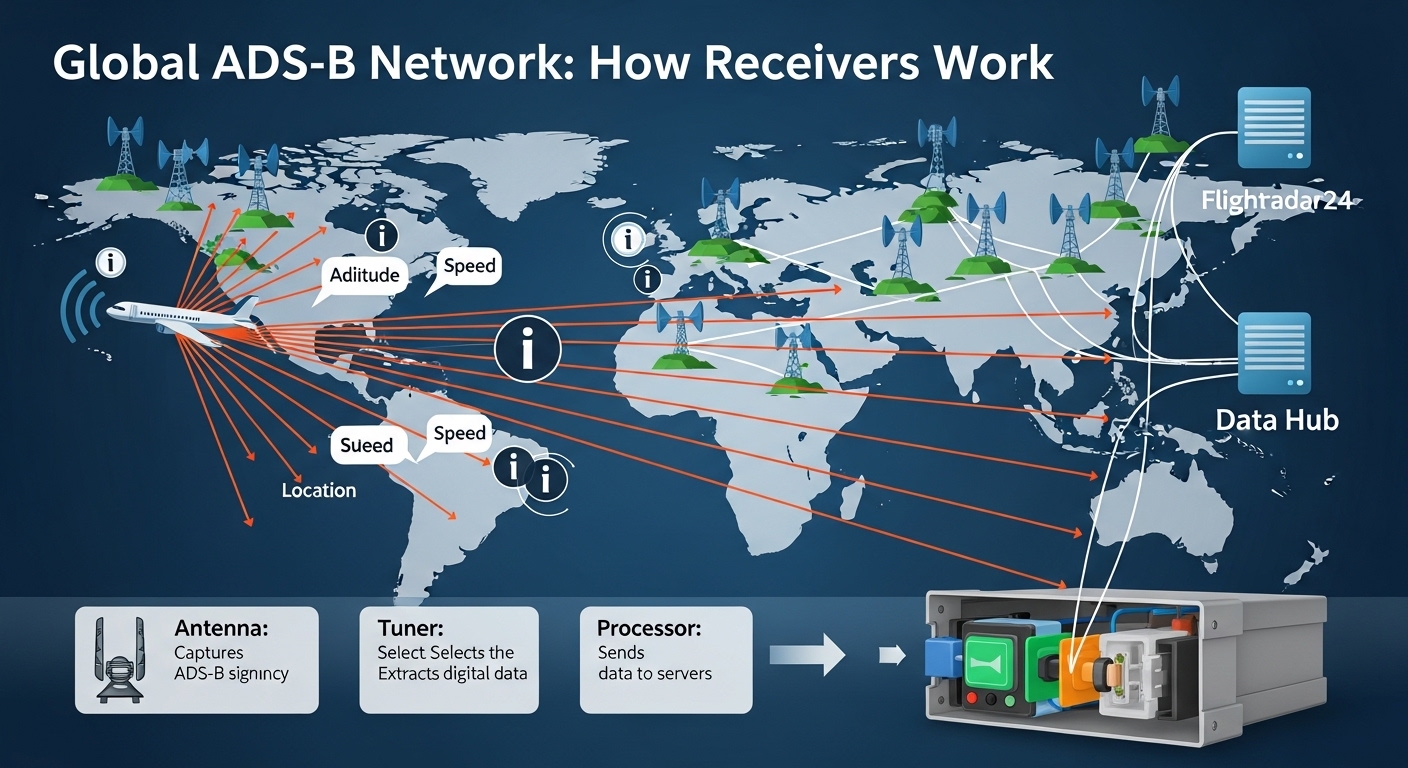
The ability to track aircraft anywhere in the world relies on a massive, invisible infrastructure known as the Global ADS-B Network. At the heart of this system are ADS-B receivers—small devices that capture aircraft broadcasts and feed real-time flight data into global tracking platforms.
What Is the Global ADS-B Network?
The Global ADS-B (Automatic Dependent Surveillance–Broadcast) Network is a worldwide collection of:
- Ground-based ADS-B receivers
- Satellite-based ADS-B systems
- Data aggregation servers
Together, they collect aircraft broadcasts and display them on live flight tracking platforms such as flight tracking apps, airline systems, and air traffic management tools.
What Is ADS-B and Why Is It Broadcast?
ADS-B is a system where aircraft automatically broadcast their position and status using onboard GPS.
Each ADS-B signal includes:
- Aircraft position (latitude & longitude)
- Altitude
- Ground speed
- Heading
- Vertical rate
- Aircraft identification (ICAO code, callsign)
These signals are transmitted every 0.5 to 2 seconds—no interrogation required.
How ADS-B Receivers Work
Step-by-Step Receiver Operation
- Aircraft transmits ADS-B signal
- Receiver antenna captures the signal
- Decoder extracts aircraft data
- Data is sent to a network server
- Flight appears on live tracking maps
Receivers operate passively – they only listen and never transmit.
Types of ADS-B Receivers
1. Ground-Based Receivers
These are installed:
- Near airports
- On rooftops
- In remote areas
- By aviation enthusiasts
Coverage range:
- 150–250 nautical miles
- Depends on altitude and terrain
2. Satellite ADS-B Receivers
Satellites equipped with ADS-B antennas capture signals from space.
Used for:
- Oceanic airspace
- Polar regions
- Remote deserts
Satellite ADS-B provides true global coverage.
What Hardware Makes an ADS-B Receiver?
A typical ADS-B receiver consists of:
- Antenna (1090 MHz)
- Software-defined radio (SDR)
- Decoder software
- Internet connection
Popular setups include:
- RTL-SDR dongles
- Raspberry Pi-based systems
Why Receiver Location Matters
ADS-B signals are line-of-sight.
Better coverage comes from:
- Higher elevation
- Clear horizon
- Low radio interference
This is why aircraft at cruise altitude are visible far away, while low-flying aircraft may disappear.
How Receivers Create a Global Network
No single receiver covers the world. Instead:
- Thousands of individuals host receivers
- Airports install professional stations
- Satellites fill coverage gaps
All data feeds into centralized servers that merge, clean, and display flight information in real time.
Why ADS-B Data Is So Accurate
ADS-B accuracy comes from:
- GPS-based positioning
- Frequent update rate
- Direct aircraft broadcast
- No radar estimation errors
This makes ADS-B more precise than traditional radar.
ADS-B Receivers vs Radar
| Feature | ADS-B | Radar |
| Position source | GPS | Signal reflection |
| Update rate | 0.5–2 sec | 5–12 sec |
| Accuracy | Very high | Moderate |
| Infrastructure cost | Low | Very high |
| Ocean coverage | Via satellite | Limited |
Who Uses ADS-B Receiver Data?
ADS-B data is used by:
- Air traffic control
- Airlines
- Flight tracking apps
- Search & rescue teams
- Researchers
- Aviation enthusiasts
Privacy and Security Considerations
ADS-B broadcasts are public by design. However:
- Military & government aircraft may limit visibility
- Some private jets opt out of public feeds
- Sensitive data may be filtered
Why ADS-B Receivers Are Critical After MH370
After the MH370 incident:
- Global tracking requirements increased
- Satellite ADS-B adoption accelerated
- Receiver coverage expanded worldwide
ADS-B now forms the backbone of global aircraft surveillance.
Future of the Global ADS-B Network
The future includes:
- Expanded satellite constellations
- AI-based signal analysis
- Improved low-altitude coverage
- Better urban air mobility tracking
By 2030, near-total real-time aircraft visibility is expected.
Frequently Asked Questions (FAQs)
Q: Can anyone run an ADS-B receiver?
Yes. Many enthusiasts operate receivers legally and contribute data.
Q: Why do some aircraft disappear from maps?
Terrain, low altitude, or restricted visibility can cause gaps.
Q: Is ADS-B more accurate than radar?
Yes. ADS-B uses GPS, making it more precise.
Q: Do receivers transmit any signals?
No. ADS-B receivers are listen-only devices.
Conclusion
The Global ADS-B Network is a powerful example of modern aviation transparency. Through thousands of receivers – on rooftops, airports, and satellites—aircraft broadcast their position to the world in real time. ADS-B receivers turn these signals into the live maps we rely on every day.
As coverage expands and AI enhances data processing, the global ADS-B network will continue to redefine how the world tracks and understands air traffic.
Leave a Reply