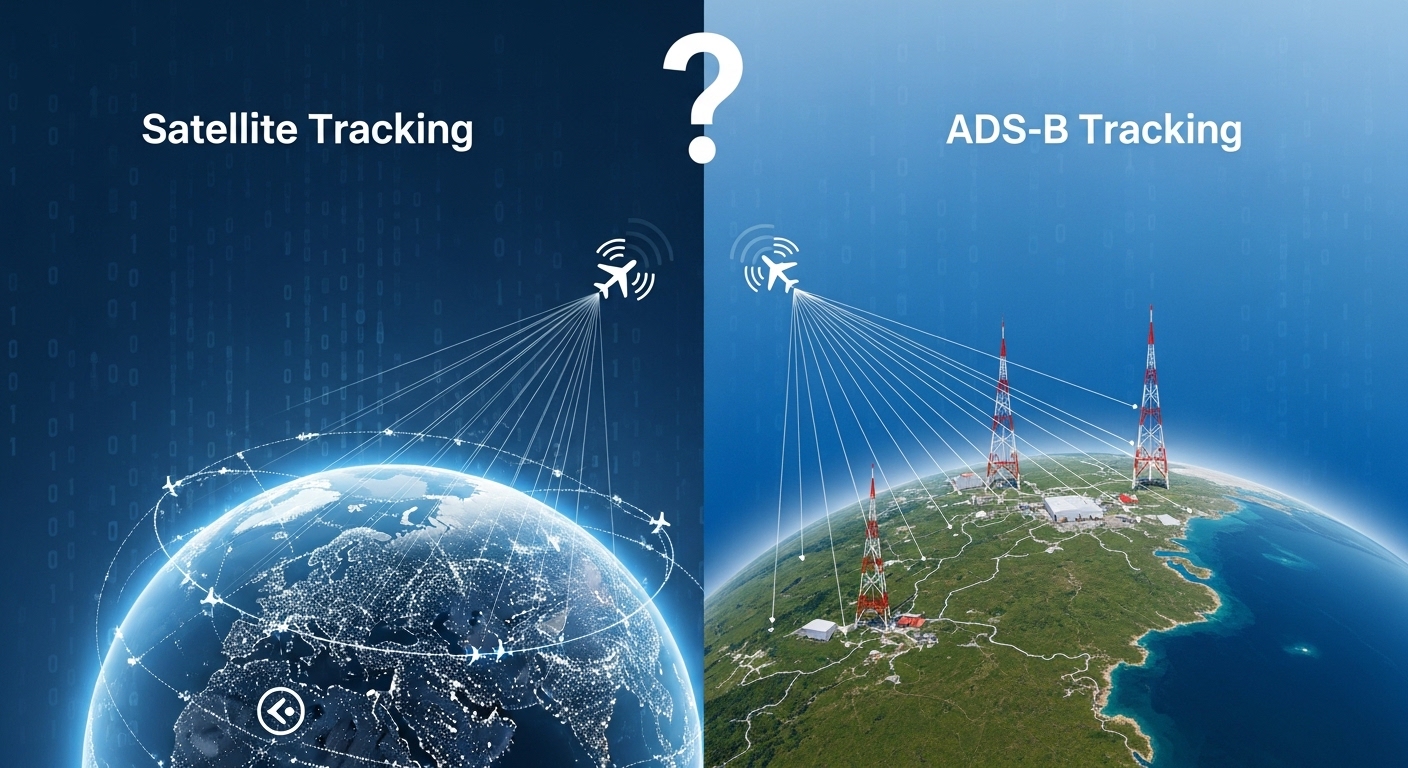
Introduction
Modern flight tracking relies on two core technologies:
ADS-B (Automatic Dependent Surveillance–Broadcast) and satellite-based tracking.
Both provide real-time information about an aircraft’s position, speed, and altitude, but they work in very different ways — and their accuracy varies depending on where the aircraft is flying.
Which one is more accurate in 2026?
Let’s break it down clearly.
What Is ADS-B?
ADS-B is a GPS-powered technology that broadcasts an aircraft’s position every 1–2 seconds.
Each broadcast contains:
- Latitude & longitude
- Altitude
- Ground speed
- Heading
- Vertical rate
- Aircraft ID
These signals are picked up by ground-based receivers, processed, and displayed on apps like Flightradar24, FlightAware, and RadarBox.
How ADS-B Works (Simplified)
- Aircraft calculates position using GPS
- Aircraft sends a broadcast on 1090 MHz
- Ground receivers collect it
- Apps combine and display the live data
ADS-B is the gold standard for precision in aviation tracking.
What Is Satellite Flight Tracking?
Satellite tracking uses orbiting satellites to receive data directly from aircraft.
This includes:
- Satellite ADS-B
- Satellite ACARS messages
- SATCOM pings
- Position reports
Its biggest advantage?
Full global coverage — even over oceans and remote areas.
This makes satellite tracking essential for long-haul flights and for maintaining continuous visibility across the planet.
Accuracy Comparison: Satellite vs ADS-B
| Feature | ADS-B (Ground-Based) | Satellite Tracking |
| Accuracy | Very High (Direct GPS)** | High (depends on satellite system) |
| Update Rate | Every 1–2 seconds | Every 5–20 seconds |
| Latency | Extremely low | Low, but slightly higher |
| Coverage | Only where receivers exist | Global |
| Best Use | Airport zones, land areas | Oceans, deserts, polar routes |
| Cost | Low | High (used by airlines, not hobbyists) |
Which One Is More Accurate?
ADS-B is more accurate.
Because ADS-B uses direct GPS data and updates incredibly fast, it provides the most precise real-time information.
- Faster refresh rate
- Lower latency
- Higher exact positional accuracy
ADS-B is so accurate that it’s the foundation for modern air traffic control systems.
Where Satellite Tracking Is Better
Even though ADS-B is more accurate, satellite tracking wins in global availability.
Satellite tracking is better when:
✔ Aircraft fly over oceans
✔ ADS-B receivers don’t exist
✔ Aircraft need continuous tracking worldwide
✔ Airlines want redundancy and safety backup
This is why long-haul flights remain visible during transoceanic operations.
How Flight Tracking Apps Use Both Systems
Apps like:
- Flightradar24
- FlightAware
- RadarBox
… combine both technologies to produce the most complete view.
Most apps use:
ADS-B → for accuracy
Satellite → for global consistency
This hybrid model ensures flights are always visible, regardless of location.
Why ADS-B Sometimes Shows Gaps
ADS-B depends on ground receivers, so tracking gaps happen over:
- Oceans
- jungles
- deserts
- mountains
- polar regions
Satellite tracking fills these gaps instantly.
Is Satellite Tracking Slower?
Yes — but only slightly.
Satellite ADS-B refreshes every 5–20 seconds depending on satellite type.
For most tracking purposes, the difference is barely noticeable.
However, for air traffic control and precision arrival management, ADS-B’s speed matters.
Which Is Better for Aviation Safety?
ADS-B: improves accuracy, prevention of mid-air conflicts, and approach management.
Satellite Tracking: ensures aircraft are never lost, even in remote airspace.
Both systems together form today’s global standard for aviation safety.
Final Verdict: What’s More Accurate?
ADS-B is more accurate
Fast GPS-based updates, extremely low latency, and high precision.
Satellite tracking is more reliable globally
Provides uninterrupted visibility anywhere on Earth.
Combined = Best overall
Modern flight tracking uses both technologies to achieve near-perfect coverage and accuracy.
FAQs
Is ADS-B more accurate than satellite tracking?
Yes. ADS-B uses direct GPS and updates every 1–2 seconds, making it more precise than satellite tracking.
Why do we still need satellite tracking if ADS-B is so accurate?
Because ADS-B only works where ground receivers exist. Satellite tracking covers oceans and remote regions.
Do apps like Flightradar24 use satellite data?
Yes, premium subscriptions combine ADS-B and satellite sources for global coverage.
Why does satellite tracking have slower updates?
Data must travel from aircraft → satellite → ground station, causing slight delay.
Is ADS-B used by ATC?
Yes. ADS-B is a primary surveillance method for modern air traffic control due to its accuracy.
Conclusion
Satellite tracking and ADS-B are both essential pillars of modern aviation, but they serve different purposes. ADS-B remains the most accurate tracking technology, delivering precise, GPS-level aircraft position updates with near-zero latency. However, satellite tracking provides something ADS-B cannot — true global coverage, ensuring that aircraft remain visible even in the most remote parts of the world, far beyond the range of ground receivers.
In 2026, the aviation industry relies on a hybrid model, combining ADS-B’s pinpoint accuracy with the worldwide reach of satellite systems. Together, these technologies have created the most reliable, transparent, and safety-focused flight tracking ecosystem in aviation history.Whether you’re an enthusiast, traveler, or aviation professional, understanding the strengths of both systems gives you a clearer picture of how modern flight tracking works — and why no single technology can replace the other. The future of aviation will continue to depend on this powerful combination of accuracy + global visibility.
Leave a Reply