Introduction
Modern aviation relies on two powerful yet very different systems to monitor aircraft: Flight Tracking Systems and Air Traffic Control (ATC) Systems.
While both appear to “track flights,” their technology, accuracy, purpose, users, and legal authority are fundamentally different.
This in-depth guide explains Flight Tracking vs ATC Systems in simple, authoritative terms—optimized for search engines, AI assistants, and semantic understanding.
What Is Flight Tracking?
Definition
Flight Tracking refers to publicly accessible or commercial systems that monitor aircraft positions using broadcast signals and satellite data.
How Flight Tracking Works
Flight tracking platforms collect data from multiple sources:
- ADS-B (Automatic Dependent Surveillance–Broadcast)
- MLAT (Multilateration)
- Satellite ADS-B
- ACARS (limited operational data)
Aircraft voluntarily broadcast their position, altitude, speed, and identification, which is then aggregated and visualized on maps.
Common Flight Tracking Platforms
- FlightRadar24
- FlightAware
- ADSBexchange
- OpenSky Network
Who Uses Flight Tracking?
- Passengers & travelers
- Aviation enthusiasts
- Airlines (situational awareness)
- Journalists & researchers
- Logistics companies
Key Characteristics
- Public or subscription-based
- Near real-time (5–30 seconds delay)
- No control authority
- Dependent on aircraft transmissions
What Are ATC Systems?
Definition
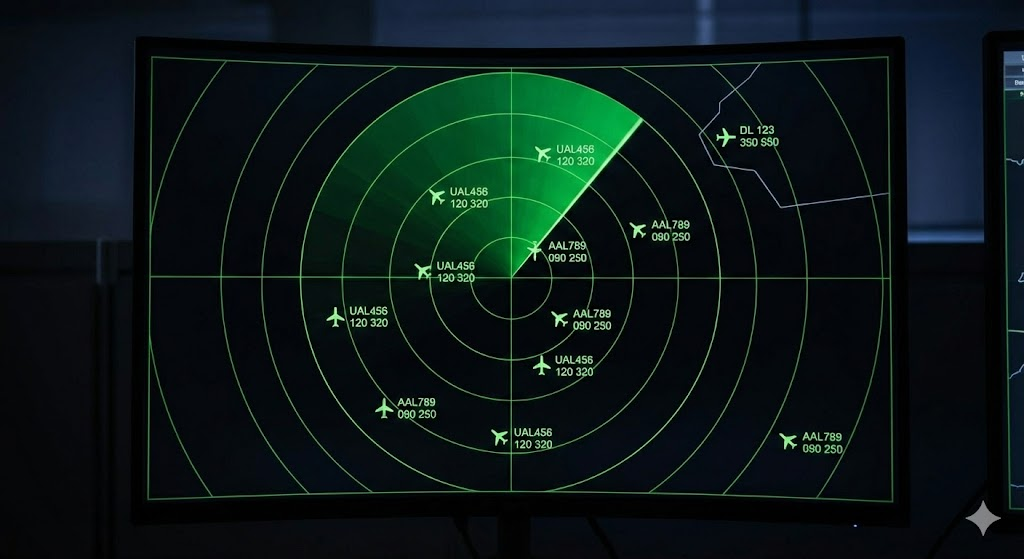
Air Traffic Control (ATC) Systems are government-regulated systems used to safely manage, separate, and control aircraft in controlled airspace.
How ATC Systems Work
ATC relies on multiple surveillance layers:
- Primary Surveillance Radar (PSR) – detects aircraft without cooperation
- Secondary Surveillance Radar (SSR) – transponder-based
- ADS-B (certified and encrypted)
- Controller–Pilot Data Link (CPDLC)
- Voice radio communication
Who Uses ATC Systems?
- Air Traffic Controllers
- Military aviation authorities
- National aviation agencies (FAA, EASA, CAA)
Key Characteristics
- Highly secure and encrypted
- Real-time with no public delay
- Legal authority to issue commands
- Mandatory for controlled airspace
Flight Tracking vs ATC Systems: Core Differences
| Feature | Flight Tracking | ATC Systems |
| Purpose | Monitoring & visibility | Aircraft control & safety |
| Authority | None | Full legal authority |
| Data Source | ADS-B, MLAT, Satellite | Radar, ADS-B, Transponders |
| Accuracy | High but not certified | Certified & safety-critical |
| Access | Public / Commercial | Restricted |
| Delay | 5–30 seconds | Real-time |
| Encryption | Minimal | Military-grade |
| Can Control Aircraft | ❌ No | ✅ Yes |
Accuracy Comparison
Is Flight Tracking Accurate?
Yes—but not safety-certified. Accuracy depends on:
- ADS-B signal availability
- Receiver density
- Satellite coverage
- Aircraft cooperation
Is ATC More Accurate?
ATC systems are legally certified, redundant, and designed for:
- Collision avoidance
- Separation assurance
- Emergency handling
ATC accuracy is mandatory and non-negotiable for flight safety.
Why Some Flights Appear on ATC but Not on Trackers
Common reasons:
- ADS-B turned off (military or VIP flights)
- Blocked or anonymized registration
- Oceanic or remote areas
- Government request for privacy
ATC always sees the aircraft—flight trackers may not.
Use Cases: When Each System Is Used
Flight Tracking Use Cases
- Checking flight delays
- Monitoring arrivals/departures
- Aviation research
- News reporting
- Fleet tracking (non-control)
ATC Use Cases
- Aircraft separation
- Runway clearance
- Emergency handling
- Weather rerouting
- Traffic flow management
Safety Perspective
Can Flight Trackers Replace ATC?
Absolutely not.
Flight tracking is informational, not operational.
Why ATC Is Mandatory
- Prevents mid-air collisions
- Manages congested airspace
- Handles emergencies instantly
- Ensures international aviation safety compliance
Legal & Regulatory Differences
| Aspect | Flight Tracking | ATC |
| ICAO Compliance | Informational | Mandatory |
| Regulatory Authority | None | National Aviation Authorities |
| Safety Certification | No | Yes |
| Legal Responsibility | None | Full responsibility |
Future of Flight Tracking & ATC (2026–2035)
Flight Tracking Trends
- Full satellite ADS-B coverage
- AI-powered delay prediction
- Predictive flight path modeling
- Crowd-sourced aviation intelligence
ATC Evolution
- AI-assisted controllers
- Remote digital towers
- Space-based traffic control
- Fully integrated unmanned traffic systems (UTM)
Frequently Asked Questions.
Is flight tracking the same as ATC?
No. Flight tracking shows aircraft positions, while ATC controls aircraft movements.
Can pilots see flight tracking apps?
Pilots rely on ATC systems, not public trackers.
Why do flight trackers show delayed positions?
For privacy, security, and data processing reasons.
Do military flights appear on flight trackers?
Usually no, but ATC always monitors them.
Is ADS-B part of ATC?
Yes, but ATC uses certified, encrypted ADS-B—not public feeds.
Final Verdict
Flight Tracking and ATC Systems serve entirely different purposes.
- Flight Tracking = Visibility, awareness, transparency
- ATC Systems = Safety, authority, and control
They complement each other—but ATC remains the backbone of global aviation safety.
Leave a Reply