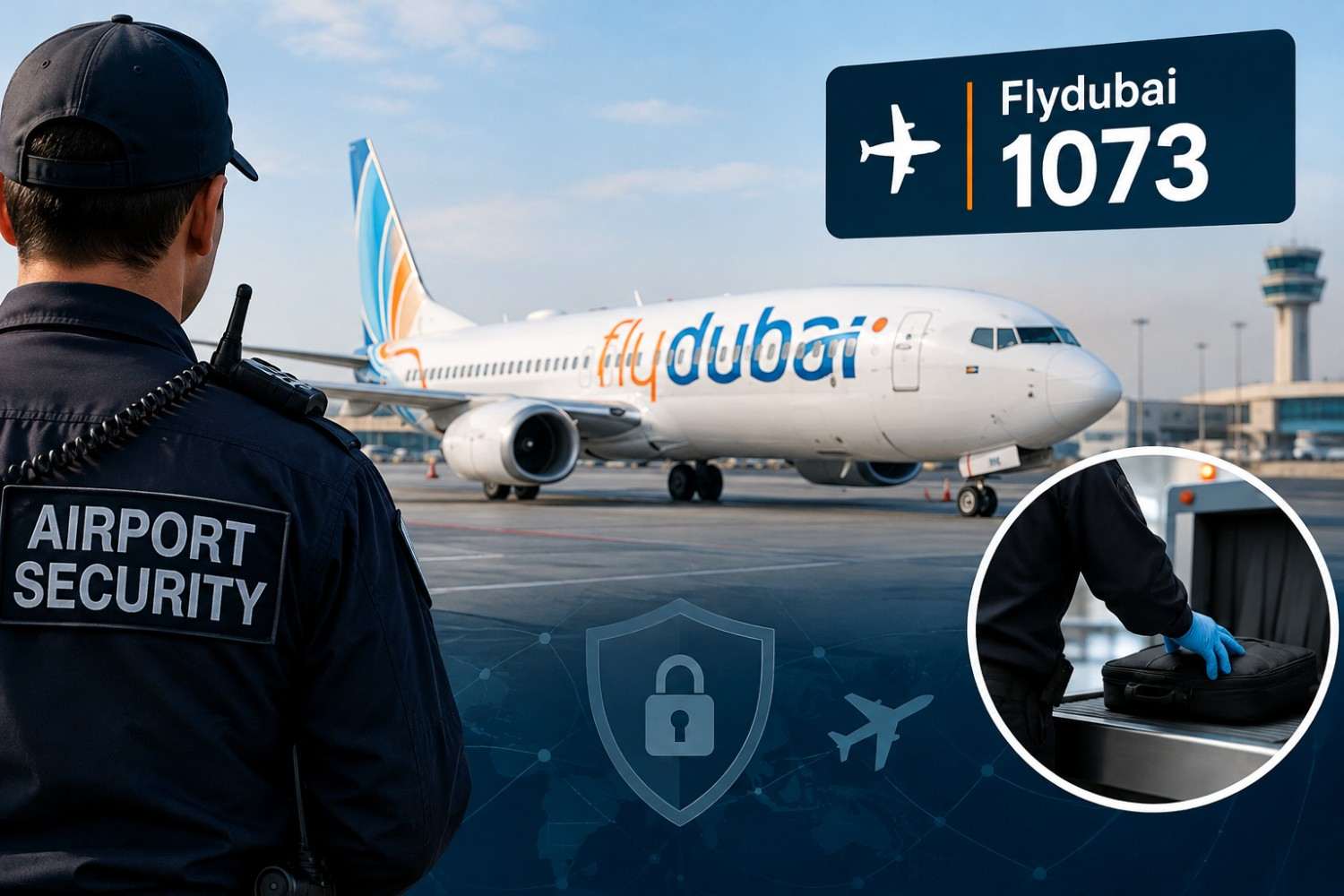
Flydubai 1073 was a September 30, 2026 flight from Dubai to Tel Aviv that diverted to Tabuk, Saudi Arabia, after the first officer allegedly attacked the captain and tried to crash the Boeing 737 MAX. The UAE attorney general says it was a planned suicide attack on Ben Gurion Airport. For aviation security, the case shifts attention from passengers and luggage to insider threats: pilot vetting, cross-border information sharing, and extra checks on sensitive routes.
What happened on Flydubai flight FZ1073?
- Departure. Flydubai flight FZ1073, a Boeing 737-8 MAX (registration A6-FKF), left Dubai at 03:05 UTC and climbed to 34,000 feet, according to Flightradar.
- The attack. Over Saudi airspace, the UAE says the first officer attacked the captain with a crash axe kept on the flight deck for emergencies. Early Israeli accounts described a stabbing. Captain Smit Machchhar, badly injured, managed to open the cockpit door.
- The dive. FlightAware data cited by ABC News showed altitude swings starting around 8:21 a.m. Israel time and a drop of more than 14,000 feet in under 30 seconds.
- The recovery. Passengers and two off-duty flydubai pilots subdued the first officer. One passenger told reporters he pulled the nose up. The off-duty pilots landed the jet at Tabuk.
- The aftermath. Saudi authorities arrested the co-pilot. Flydubai suspended its flights to and from Israel while the investigation continues.
Anyone with a live flight tracker could see part of this. Flightradar24 reported that the aircraft squawked 7700 (general emergency) and 7500 (unlawful interference). A plane tracker can’t show a cockpit, but it did give journalists a timestamped, public record of the dive. That is why a live flights tracker now sits next to official statements in how investigators and reporters reconstruct events.
Who is saying what about the Flydubai 1073 incident?
The UAE prosecution view. Attorney General al-Shamsi says first officer Hamam al-Hammami, an Omani national, planned to seize the flight and crash it into a terminal at Ben Gurion. The Times of Israel reports that he used two earlier Tel Aviv flights to learn the route and airport, viewed pro-terror material and took boxing lessons. The UAE also says its procedures found no sign of extremist views or a plot beforehand.
The Israeli government view. Israeli officials say they will strengthen precautions and pilot vetting for incoming flights, per AviationA2Z. Prime Minister Netanyahu credited the captain with saving everyone aboard by holding on long enough to open the door.
The security-analyst view. Eyal Hulata, Israel’s former national security adviser, told the AP that security has traditionally focused far more on passengers and baggage than on a threat from a pilot or crew member. Aviation blogger Cranky Flier goes further, arguing that Israel relies on airlines to police a pilot-origin rule and that flydubai should not have rostered this first officer on the route. That is commentary, not a finding.
The airline and passenger view. Flydubai has urged against speculation while authorities investigate. Meanwhile, Calcalist reports that most passengers are preparing a class action against the airline and the Israeli and UAE transport ministries.
Insider threat vs outside hijacking: what is the difference?
The one distinction that explains most of the others is where the threat enters the system. A classic hijacking starts in the cabin, so defenses sit at the checkpoint and the cockpit door. An insider attack starts on the flight deck, so those same defenses can work against the crew. AP reporting notes that cockpit doors were reinforced and locked after September 11 to keep intruders out, and that the FZ1073 case highlights the risk when the danger is already inside.
| Outside hijacking | Insider (pilot) attack | |
| Where the threat starts | Passenger cabin | Flight deck |
| Main defenses | Passenger and baggage screening, reinforced door | Hiring checks, information sharing, crew oversight |
| Effect of the locked door | Keeps the attacker out | Can keep help out |
| Who intervened on FZ1073 | Not applicable | Wounded captain, passengers, two off-duty pilots |
What security gaps did Flydubai 1073 expose?
Three gaps recur in the reporting. All three are reported or alleged, and investigators have not yet ruled on any of them.
1. Vetting that stops at paperwork. Minute Mirror reports that Omani authorities identified a security concern about the first officer in 2024, yet his licence was not revoked and no criminal case was filed. It also cites the Wall Street Journal as reporting that flydubai did not contact his previous employer, Oman Air, before hiring him. Flydubai has not publicly answered those specific claims.
2. Information that does not travel. The International Civil Aviation Organization sets baseline vetting and licensing standards, while national regulators and airlines may add their own, according to the AP. The open question is whether a concern raised by one aviation employer or country reliably reaches the next one.
3. Route rules that rely on self-policing. Cranky Flier argues that Israel leaves it to airlines to enforce which pilots may fly its routes. Israeli officials have said they will tighten pilot checks for incoming flights. If an airline’s roster is the last line of defense, the quality of that roster check matters as much as any checkpoint.
What could change in aviation security after Flydubai 1073?
Only one change has been announced so far: Israel’s stronger checks on pilots flying into the country. The other four below are my read of where the pressure points to, not confirmed policy.
- Stronger pilot checks on sensitive routes. Announced by Israeli officials, details pending.
- Deeper pre-employment vetting. Airlines could be expected to contact previous employers and regulators directly, not just verify a licence.
- A cross-border channel for security concerns. A flag raised by one country’s authorities could be made visible to the next employer, with privacy and legal safeguards.
- Review of flight-deck procedures. Regulators could revisit what is kept in the cockpit and how the door protocol works when the threat is inside.
- Closer oversight of route-familiarization patterns. The UAE says the first officer flew two earlier Tel Aviv services to learn the airport, a detail investigators will likely weigh.
For travelers, the practical effect may be small. For airlines flying politically sensitive routes, the compliance burden could grow.
Which Flydubai 1073 numbers are reliable, and which are disputed?
Sources disagree on several figures. Here is what each reported, so you can cite the right one.
| Detail | Reported figure | Source |
| People on board | 174 in some reports; 182 including eight crew in others | AP versions, AviationA2Z |
| Altitude lost | More than 14,000 ft in under 30 seconds | FlightAware via ABC News |
| Altitude lost | 16,000 ft in 30 seconds | UAE account via Times of Israel |
| Altitude lost | 17,000 ft in under a minute | Flightradar24 |
| Cruise altitude | 34,000 ft | Flightradar24 |
| Aircraft | Boeing 737-8 MAX, A6-FKF | Flightradar24 |
Myth-busting
Myth: locked cockpit doors make a hijacking impossible. The doors were designed to keep intruders out. On FZ1073 the alleged attacker was already inside, and the door that mattered was the one the injured captain opened.
Myth: this was a failure of airport screening. The reporting centers on hiring and information sharing. Checkpoint screening of passengers and bags would not obviously stop a licensed crew member.
Myth: a single passenger saved the flight. Accounts differ. The captain opened the door, passengers subdued the first officer, one passenger said he leveled the jet, and two off-duty pilots landed it.
Is Flydubai 1073 a hijacking, sabotage or a pilot suicide?
It depends on the finding, and the finding isn’t in yet. Flightradar24 describes the incident as most likely a failed hijacking. The UAE describes a planned terror attack. Neither matches the pilot-suicide cases that shaped earlier security thinking.
- Clearly an insider-caused crash: Germanwings Flight 9525 (2015), in which the co-pilot deliberately crashed the aircraft.
- Borderline: EgyptAir Flight 990 (1999), where a US finding pointed to deliberate action by a relief first officer, which Egyptian authorities disputed.
- FZ1073: an alleged ideologically driven plot, according to the UAE, stopped before it could succeed. As Cranky Flier notes, everyone on board survived.
The label matters because each leads to a different fix: mental-health screening for one, hiring and intelligence checks for the other.
What is the takeaway from Flydubai 1073?
The plain version: the most dangerous gap in aviation security may sit in the hiring file, not at the checkpoint.
If you follow the industry, watch for three things: the formal investigation findings, any rule changes from Israel and the UAE, and whether regulators set up a way to share pilot security concerns across borders. If you want to follow the next incident as it unfolds, open a plane tracker, search the flight number, and compare what the data shows with what officials later say.
Figures in this article are as reported on October 14, 2026, and may change as the investigation proceeds.
FAQ
What happened on Flydubai flight 1073? On September 30, 2026, the first officer allegedly attacked the captain on a Dubai–Tel Aviv flight. Passengers and two off-duty pilots intervened, and the jet landed at Tabuk, Saudi Arabia.
Did anyone die on Flydubai 1073? No deaths have been reported. Captain Smit Machchhar was badly injured but opened the cockpit door that let others reach the flight deck.
Who is the co-pilot accused in the Flydubai incident? Media reports and UAE officials identify him as Hamam al-Hammami, an Omani national. Saudi authorities arrested him after the landing, and the allegations have not been tested in court.
Why did Flydubai 1073 dive so fast? The UAE says that once the plan to reach Tel Aviv failed, the first officer pushed the jet into a dive. Reported losses range from 14,000 to 17,000 feet in 30 to 60 seconds.
Can I see the Flydubai 1073 flight path on a live flight tracker? Past flights need a tracker’s history feature, which is how reporters cited FlightAware and Flightradar24 data. A live flights tracker shows current altitude, speed and squawk codes for aircraft in the air.
How do I track airline flights live? Open a plane tracker, search the flight number or airline, and read the altitude, speed and squawk code. Squawk 7700 signals a general emergency and 7500 signals unlawful interference.
Will Israel change its pilot checks after Flydubai 1073? Israeli officials have said they will strengthen security checks on pilots flying into the country. Flydubai says the incident has no impact on its other scheduled routes, though its flights to and from Israel are suspended.
Leave a Reply